


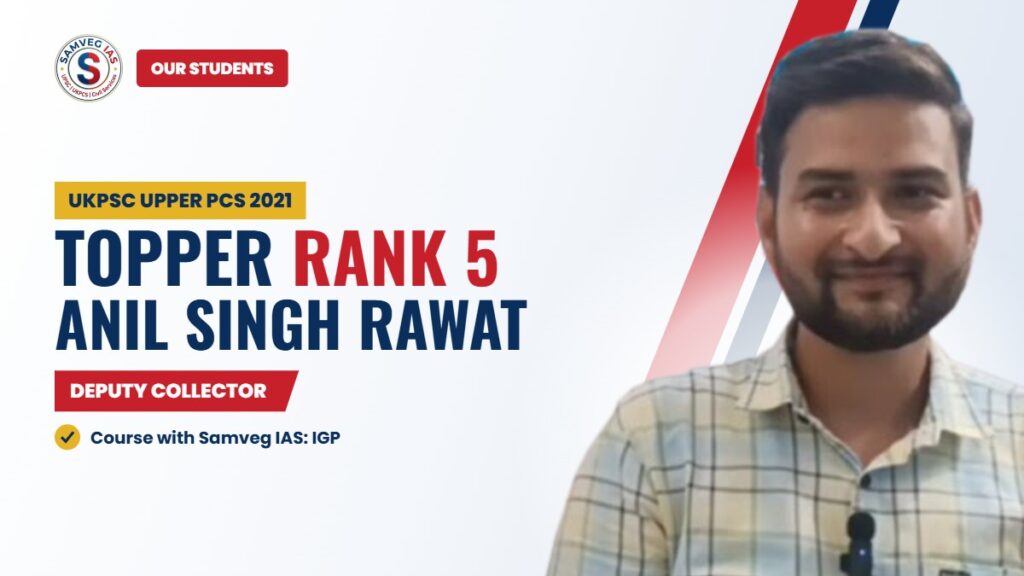
Anil Singh Rawat Rank 5 UKPSC 2021: Deputy Collector
The UKPSC Upper PCS 2021 result brought great news for a Hindi-medium aspirant. Anil Singh Rawat Rank 5 UKPSC 2021 secured the post of Deputy Collector. Moreover, he cleared the exam in his first attempt, after five years of steady effort.
He shared his integrated approach in a warm success talk with SAMVEG IAS. So, here are the key lessons from his journey.
Major Highlights of Anil Singh Rawat’s Interview with Samveg IAS
An Emotional Result Day
The result came on the 28th. At first, Anil checked the PDF three or four times. Then, overwhelmed with emotion, he bowed at his parents’ feet. Finally, as calls started coming in, the news sank in. He had only hoped to see his name in the list. However, he got Rank 5 instead.
Background and Motivation
His interest began at Jawahar Navodaya Vidyalaya, Pokhal. There, his social science teacher, Shri Rajesh Kumar, was himself facing civil services interviews. First, he explained to Anil what civil services are. Then, he praised Anil’s answers and showed him how to improve them.
Later, in Class 8, Anil met an IAS officer of the Madhya Pradesh cadre. He asked what habit would help him in the future. The advice was simple: read your NCERTs properly. Also, reading meant understanding, not just memorising. So, he studied Class 9 and 10 social science very seriously. From then on, civil services became his clear goal.
Integrated Preparation for All Three Stages
Anil believes prelims, mains and interview run together. For example, learning facts and solving MCQs prepares you for prelims. Then, writing the same concept as an answer prepares you for mains. Similarly, discussing it with a friend prepares you for the interview. After all, the book list stays the same.
As a result, clearing one stage gives you confidence for the next. Moreover, he suggests only one to one and a half months of final prelims practice. During this time, solve MCQs, previous year questions and a test series.
Mains Strategy of Anil Singh Rawat Rank 5 UKPSC 2021
For mains, he relied on a test series and regular answer writing. First, he turned every topic into a fixed format:
- Introduction: A short, clear opening.
- Main body: Points such as pros, cons and suggestions.
- Way forward: Practical steps ahead.
- Conclusion: A balanced closing line.
Everyone reads similar content. However, presentation makes the difference. So, he used flow diagrams and pie charts. Also, he revisited his answers after a week and added value. Then, he gave them to friends for honest feedback. “A friend will find ten more mistakes,” he says with a smile.
Interview and Mock Interviews
The interview is a personality test. Therefore, Anil read current issues of Uttarakhand, India and the world. Then, he practised speaking about them. Two to four mock interviews give you confidence before a panel. Also, they help with posture, hand movements and a natural smile.
However, he warns against taking mocks too seriously. Sometimes they can even feel demotivating. In fact, he describes the UKPSC interview as very easy-going. The board members make you feel comfortable.
Resources for the New Mains Pattern
Mains now has four GS papers on the UPSC pattern. So, Anil suggests standard sources. Also, see our UKPSC Upper PCS exam guide for the full pattern.
- History: Old NCERTs, then Bipin Chandra or Spectrum for modern India.
- Geography: NCERTs from Class 6 to 12.
- Society and social justice: Any good value-addition material, such as Vision’s.
- Polity: Laxmikanth is enough if you also practise writing.
- Economy: Ramesh Singh, or concise notes when time is short.
- Ethics: Lexicon for quick revision, along with Subba Rao and case studies.
- Uttarakhand papers: He read Winsar Year Book and Pariksha Vani. For history, he also suggests Ajay Rawat and Yashodhar Mathpal.
Above all, keep resources limited and revise many times. Also, do not make separate notes. Instead, the answers you write become your notes. That way, you may even finish your GS paper five to ten minutes early.
Patience, Good Company and Social Media
The Uttarakhand process can take three to four years. Hence, patience is essential. So, ignore what people say. Instead, read good books, listen to good people and keep good company. Also, talk to yourself and introspect. If you grow a little every day, demotivation will not touch you.
On social media, he prefers balance. For instance, his focus lasts about 55 minutes. After that, five minutes of reels can refresh him. However, too much screen time steals study time.
His Success Mantra
Anil lists three basic abilities: reading, writing and speaking. Along with them, an aspirant needs hard work, patience and a desire to excel. “Only your answer copy reaches the examiner, not your face,” he reminds aspirants. So, learn to say a lot in limited words. That is the core advice of Anil Singh Rawat Rank 5 UKPSC 2021.
Association with SAMVEG IAS
Anil joined our Interview Guidance Programme (IGP). It included offline orientation classes and mock interviews. According to him, the classes covered current Uttarakhand issues and recent interview trends. He found this guidance helpful. Still, the credit for this result belongs to his own hard work and patience. We congratulate him and wish him the very best.
Watch the full interaction with Samveg IAS:

Check out all our students who cleared UKPSC Upper PCS 2021.