

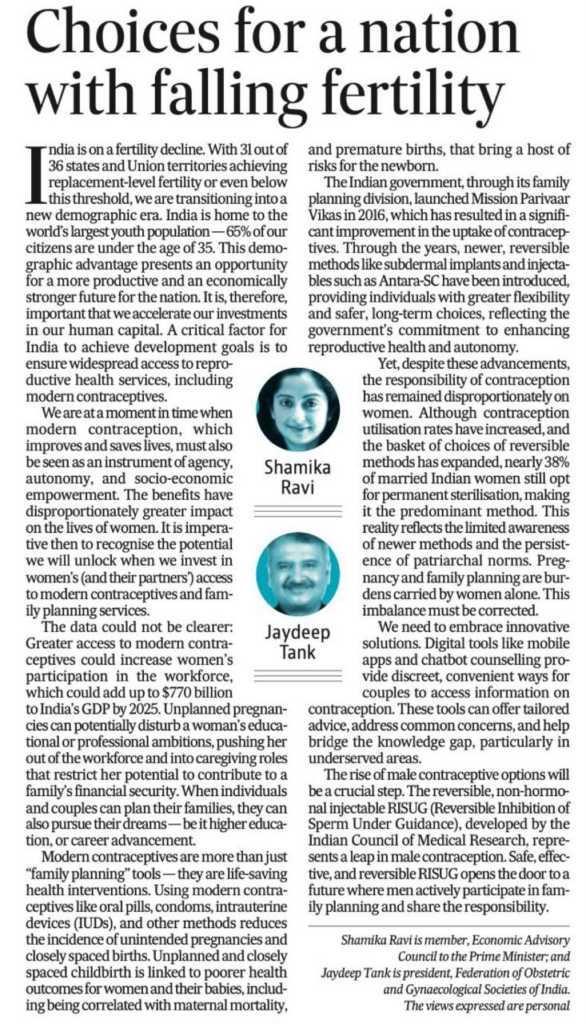
India’s fertility is declining. In fact, 31 of 36 states and Union Territories are now at or below replacement level. This India fertility decline marks the start of a new demographic era. Therefore, experts argue that investing in modern contraceptives is key to empowering women and boosting the economy.

What Is Replacement-Level Fertility?
Replacement-level fertility is the average number of children per woman needed to keep a population stable. Generally, this total fertility rate (TFR) is about 2.1. So, when a state falls below it, its population will eventually stop growing.
India Fertility Decline and the Demographic Dividend
India has the world’s largest youth population. Notably, about 65% of citizens are under 35. This demographic advantage offers a chance to build a more productive and stronger economy. However, India must invest faster in human capital to use it well.
Why Access to Contraception Matters
- Economic gains: Wider access to modern contraceptives could raise women’s workforce participation. According to the analysis, this could add up to $770 billion to India’s GDP by 2025.
- Health benefits: Moreover, modern methods reduce unintended pregnancies and closely spaced births. In turn, this lowers risks such as maternal mortality and premature births.
- Agency for women: Finally, planned families let women pursue higher education and careers.
Government Initiatives
The government launched Mission Parivar Vikas in 2016. Since then, the uptake of contraceptives has improved significantly. In addition, newer reversible methods like subdermal implants and the injectable Antara-SC now offer more choices.
India Fertility Decline: Challenges and Way Forward
- Burden on women: Nearly 38% of married Indian women still opt for permanent sterilisation. Clearly, this reflects low awareness of newer methods and persistent patriarchal norms.
- Digital tools: Therefore, mobile apps and chatbot counselling can offer discreet advice, especially in underserved areas.
- Male contraception: Similarly, RISUG (Reversible Inhibition of Sperm Under Guidance), developed by ICMR, is a non-hormonal male injectable. It can help men share responsibility for family planning.
Source: Opinion article by Shamika Ravi (Economic Advisory Council to the PM) and Jaydeep Tank (FOGSI).
Syllabus link: Population, health and women’s empowerment. For official data, visit the Ministry of Health and Family Welfare. Also, read our note on the High-Level Committee on Demographic Change.
Preparing for the UKPSC Upper PCS 2026 prelims? Join our UKPSC 2026 Prelims Test Series for regular practice.