


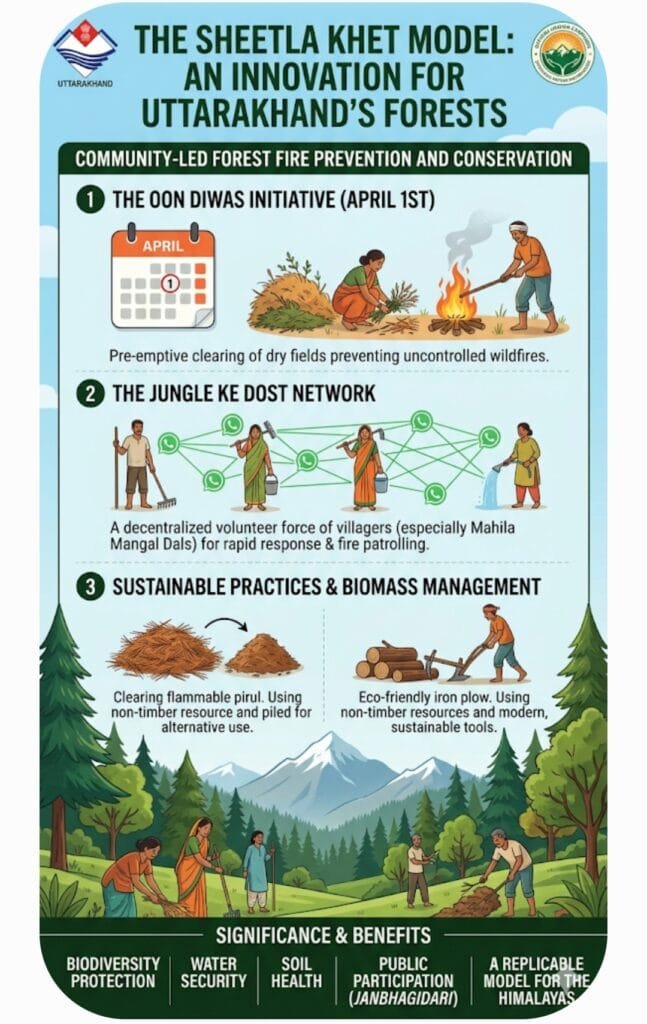
Sheetlakhet model of Uttarakhand
The Sheetlakhet Model of Uttarakhand is an acclaimed, community-driven framework for environmental conservation, primarily recognized for its breakthrough success in preventing forest fires (vanagni) and revitalizing local ecology.
Originating in Sheetlakhet—a scenic, forested village cluster in the Almora district of the Kumaon region—this grassroots initiative relies on public participation (Janbhagidari) rather than top-down administrative policing. Its resounding success has prompted the state government to adopt it as a blueprint for forest protection across Uttarakhand.
1. Core Mechanics: How the Sheetlakhet Model Works
Historically, forest departments act after a fire breaks out. The Sheetlakhet Model completely shifts the focus to pre-emptive, community-led management before the dry fire season (March to June) even begins.
The Strategy of “Oon Diwas” (Oon Day)
In the hill regions, farmers traditionally clear dried bushes, weeds, and agricultural residues from farm boundaries before the Kharif sowing season by burning them—a practice locally known as Oon, Aada, or Keda burning.
- The Problem: Traditionally, this was done in April or May. By this time, temperatures spike, dry pine needles (pirul) carpet the forest floor, and strong winds whip up. A single stray spark from a farm boundary would instantly ignite devastating forest fires.
- The Solution: The Sheetlakhet Model structured a deadline. Under the banner of local community groups like “Jungle Ke Dost” (Friends of the Forest), villagers agreed to cut all agricultural weeds during winter and burn them strictly before March 31, before the environment became dangerously dry.
- Commemoration: To cement this practice, April 1st is celebrated annually across Almora as “Oon Diwas” (Oon Day)—marking the successful, safe completion of agricultural burning before the fire season begins.
The “Jungle Ke Dost” Network
The movement is driven largely by local women’s groups (Mahila Mangal Dals) and youth networks connected via instant messaging platforms like WhatsApp.
- Rapid Response: If a fire breaks out despite precautions, the digital network ensures that dozens of villagers arrive at the spot immediately, drastically minimizing response time before forest department units can reach the remote terrains.
- Biomass Management: Villagers proactively clear dry pine needles and flammable biomass from areas bordering residential spaces and agricultural land.
Reducing Forest Exploitation
To lower the dependency on cutting forest trees to make heavy wooden agricultural tools, the initiative partnered with the Vivekananda Hill Agriculture Research Institute in Almora to distribute eco-friendly iron ploughs to thousands of local farmers across the hill districts.
2. Environmental & Socio-Economic Significance
The Sheetlakhet Model holds profound ecological, economic, and social significance for mountain ecosystems facing the brunt of climate change:
- Massive Reduction in Forest Loss: Over the last decade, the collective efforts have protected hundreds of hectares of pristine forest land. This safeguards biodiversity, including rare Himalayan flora and fauna, and prevents dense smoke from altering regional microclimates.
- Water Security & Soil Health: Forest fires bake the mountain soil, rendering it hydrophobic (water-repellent), which accelerates flash floods and dries up natural mountain springs (gad-gdeeras). By preventing fires, the model preserves the forest canopy, allowing the roots to act as natural sponges that recharge local water bodies, such as the vital Kosi River ecosystem.
- True Grassroots Governance (Janbhagidari): It changes the psychological dynamic from “the government’s forest” to “our forest.” It empowers mountain women—who are the primary managers of fuel, fodder, and livestock in the hills—giving them a central voice in climate adaptation.
- A Model for the Entire Himalayan Arc: Mountain topographies across the globe struggle with wildfires due to changing weather patterns. Sheetlakhet proves that low-cost, traditional wisdom combined with simple coordination can outperform expensive institutional fire-fighting measures.