

The Namo Bharat Rishikesh extension could transform regional connectivity in Uttarakhand. After persistent efforts by Chief Minister Pushkar Singh Dhami, three parties reached a landmark consensus. These are the Government of Uttarakhand, the Government of Uttar Pradesh and the National Capital Region Transport Corporation (NCRTC).
Under this plan, the Regional Rapid Transit System (RRTS), popularly called the Namo Bharat train, will expand further. Currently, it ends at Modipuram in Meerut. In future, it will run up to Lakshman Jhula in Rishikesh. Meanwhile, a joint survey to prepare the Detailed Project Report (DPR) will begin immediately.

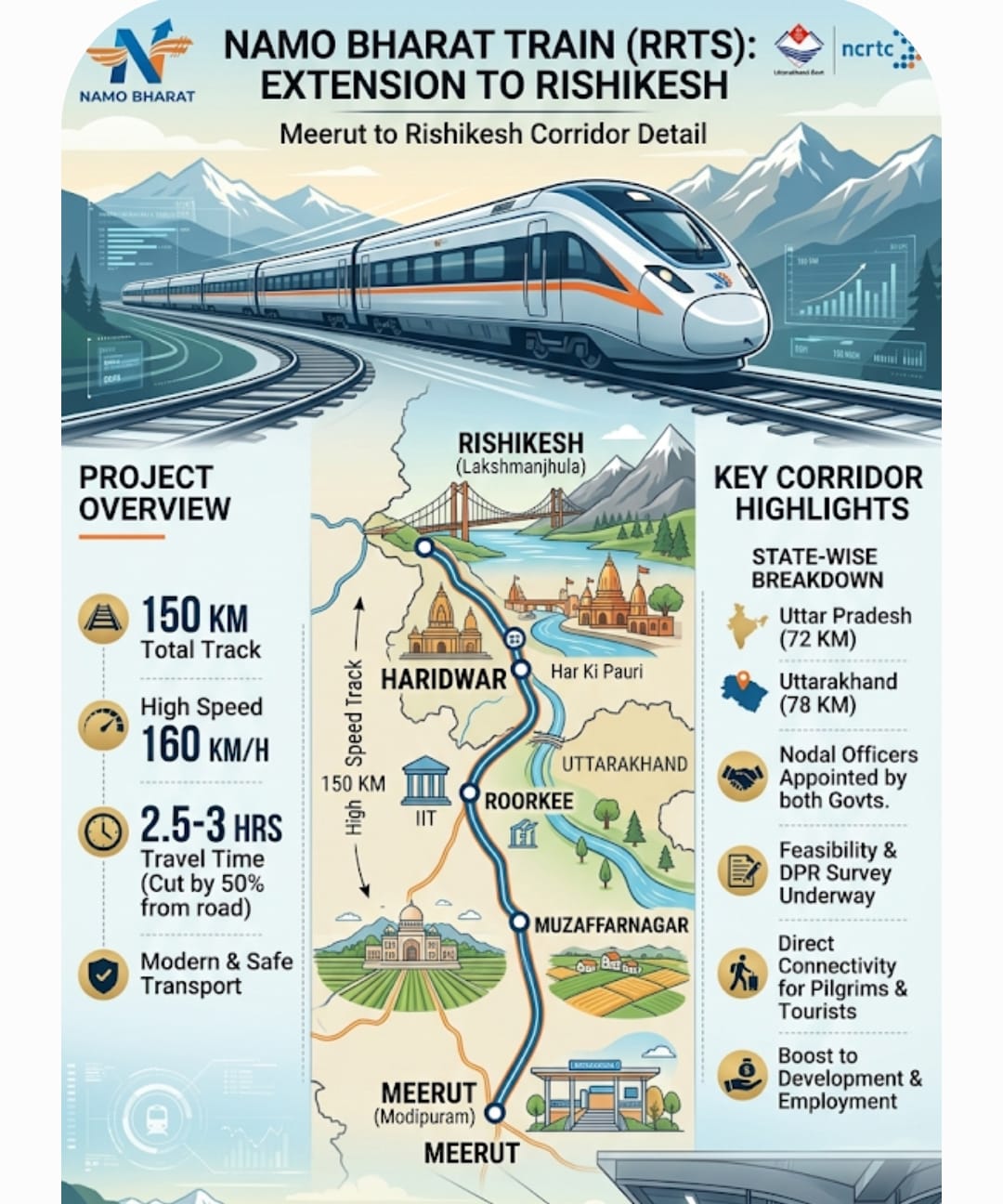
1. Namo Bharat Rishikesh Route and Specifications
The proposed rapid rail link spans 150 kilometres. Thus, it will link the National Capital Region (NCR) directly with the spiritual heartland of Uttarakhand. The corridor splits across state boundaries as follows:
- Total track length: 150 km
- Uttar Pradesh stretch: 72 km
- Uttarakhand stretch: 78 km
- Design and operational speed: 160 km/h
The high-speed alignment will branch out from the existing Modipuram Station (Meerut). From there, it will pass through major socio-economic and religious hubs before reaching Lakshman Jhula.
2. Institutional Framework and Execution
To ensure quick decisions and smooth inter-state coordination, the partners have set up special administrative pillars:
- Nodal Officer (Uttarakhand): Additional Secretary Reena Joshi will oversee clearances, land evaluation and logistics within the state.
- NCRTC integration: Similarly, the NCRTC has appointed a parallel nodal officer. This officer will align technology and engineering standards.
- Inter-state synergy: The Government of Uttar Pradesh has formally given its consent. Hence, the joint DPR survey can now go ahead.
3. Impact of Namo Bharat Rishikesh Link on Uttarakhand
Uttarakhand depends heavily on religious tourism. It also faces the twin challenges of ecological protection and outward migration. Therefore, this project offers several strategic advantages.
A. Faster Travel
At present, a road trip from Delhi to Rishikesh takes roughly 5 to 6 hours. Moreover, seasonal traffic jams often make it longer. However, the Namo Bharat train will run at 160 km/h. As a result, it will cut travel time to just 2.5 to 3 hours, nearly half the current time.
B. Boost to Pilgrimage Tourism (Char Dham Base)
Haridwar (Har Ki Pauri) and Rishikesh are the main gateways to the Char Dham Yatra. So, fast, weather-resilient rail links will offer a modern option for millions of devotees from India and abroad. In addition, they will reduce pressure on state highways.
C. Economic Growth and Local Jobs
Better access will also boost local businesses, hospitality and institutions in Roorkee and Haridwar. According to CM Dhami, modern transport directly supports sustainable regional development. Furthermore, it creates new livelihood opportunities for local youth.
Namo Bharat Rishikesh Extension: Exam Relevance
Syllabus link: Economy of Uttarakhand – infrastructure, transport and tourism development.
For project details, visit the National Capital Region Transport Corporation. Also, read our note on the road network of Uttarakhand.
Preparing for the UKPSC Upper PCS 2026 prelims? Join our UKPSC 2026 Prelims Test Series for regular practice.