Ethanol Blending in India: The Water-Energy Paradox
1. Context & Policy Background
India is aggressively pursuing the Ethanol Blended Petrol (EBP) Programme to reduce its dependence on expensive crude oil imports (approx. 85% imported) and to achieve carbon emission targets.
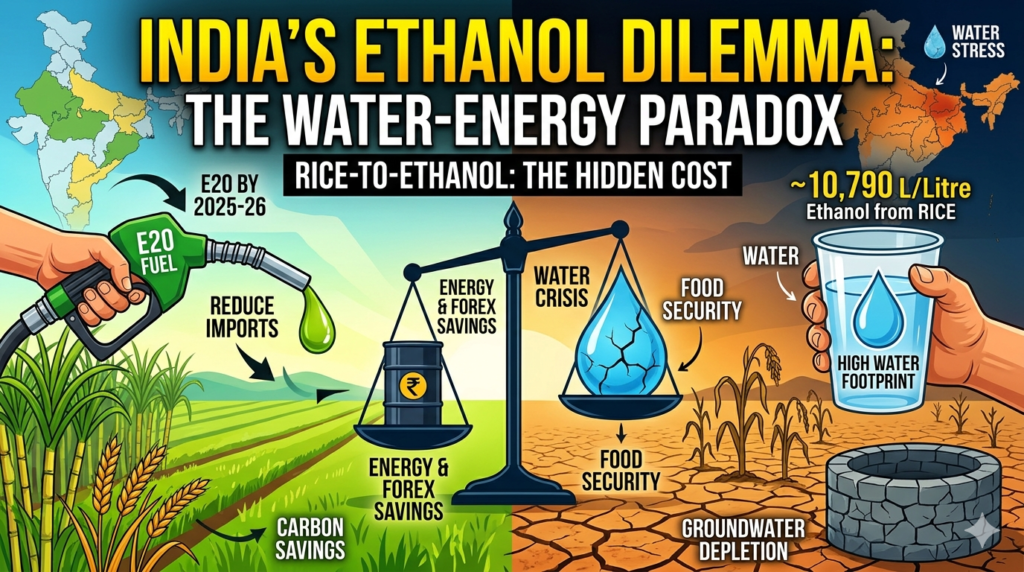
- Current Target: India aims to achieve 20% ethanol blending (E20) by 2025-26.
- Feedstock Shift: Initially dependent on sugarcane (molasses), the government has now pivoted towards using surplus food grains, specifically rice and maize, to meet production targets.
2. The Critical “Water Footprint” of Ethanol
The most alarming takeaway from the recent NITI Aayog warnings and environmental data is the hidden water cost of “green” fuel.
- Rice-to-Ethanol: Producing 1 litre of ethanol from rice requires ~10,790 litres of water.
- Why? Rice is a water-guzzler; 1 kg of rice takes ~3,000 litres of water to grow. However, 1 tonne of rice only yields ~470 litres of ethanol.
- Comparative Analysis:
- Maize: ~4,670 litres of water per litre of ethanol.
- Sugarcane: ~3,630 litres of water per litre of ethanol.
- Wastewater Generation: Ethanol mills produce large volumes of vinasse (wastewater). If untreated, this causes severe soil and groundwater pollution.
3. Socio-Economic Impact: “Fuel vs. Food”
- PDS Diversion: To ensure feedstock for distilleries, the government is reducing the share of broken rice in the Public Distribution System (PDS) from 25% to 10%.
- Concerns: This raises ethical and food security questions—diverting affordable grain from the plates of the poor to fuel tanks of the middle/upper class.
4. Geographical & Environmental Stress
- Groundwater Depletion: Much of the ethanol production is concentrated in water-stressed states like Maharashtra, Uttar Pradesh, and Karnataka.
- NITI Aayog Warning: The Composite Water Management Index (CWMI) warns that 21 major Indian cities (including Delhi and Bengaluru) could run out of groundwater by 2030.
- Regional Imbalance: States like Punjab and Haryana, already facing desertification due to monoculture, are now growing these crops for industrial-scale fuel, further accelerating the collapse of the water table.
5. Challenges (Critical Analysis)
- Policy Conflict: On one hand, the Ministry of Agriculture promotes “More Crop Per Drop,” while on the other, the Fuel Policy encourages water-intensive crops for ethanol.
- Renewable Energy Definition: Is it truly “green” if the carbon savings from the tailpipe are offset by ecological destruction (water depletion and land degradation) during production?
- Economic Viability: While it saves foreign exchange (Forex), the long-term cost of restoring groundwater or managing water scarcity could outweigh these savings.
6. Way Forward / Suggestions
- Diversification of Feedstock: Shift focus to Second Generation (2G) Ethanol, which uses agricultural waste (parali/stubble) rather than food grains.
- Incentivizing Less Water-Intensive Crops: Promote maize over rice and sugarcane in water-stressed regions.
- Water Accounting: Mandate “Water Footprint” audits for all ethanol distilleries.
- Zonal Planning: Distilleries should only be permitted in water-surplus regions or required to use recycled urban wastewater.
Quick Facts for Prelims:
Ethanol Blending in India:
- E20 Target Year: 2025-26.
- Nodal Agency: Department of Food and Public Distribution (DFPD).
- Feedstocks Allowed: Sugarcane juice, B & C-heavy molasses, damaged food grains (rice, maize), and surplus rice from FCI.
- Major Producers: Uttar Pradesh, Maharashtra, Karnataka.