
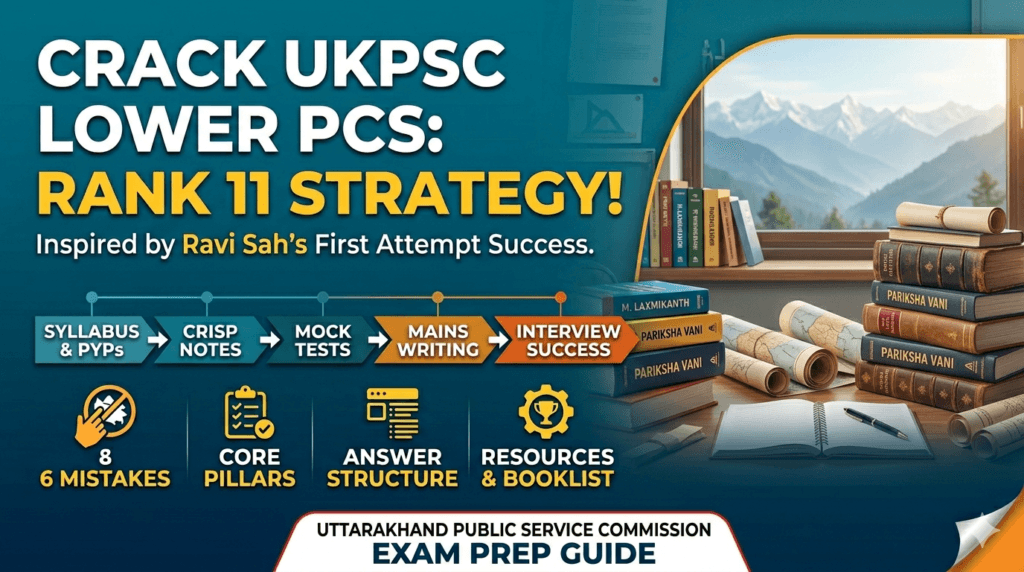
UKPSC Lower PCS Preparation Strategy
Cracking the Uttarakhand Public Service Commission (UKPSC) Lower PCS exam requires more than just hard work; it demands a meticulous plan, disciplined execution, and a clear understanding of what not to do.
In this comprehensive guide, we break down the definitive UKPSC Lower PCS Preparation Strategy, inspired by the journey of Ravi Sah (Rank 11, Lower PCS). A software engineer with six years of corporate experience, Ravi left his job, shifted from Delhi to Dehradun, and cleared the exam in his very first attempt.
Whether you are a beginner or an experienced aspirant, this blueprint will help you streamline your preparation, avoid common pitfalls, and master every stage of the exam.
6 Critical Mistakes to Avoid During Your Preparation
Many serious candidates miss the merit list not due to a lack of effort, but due to strategic errors. Ravi Sah highlights the top mistakes you must curb immediately:
- Ignoring the Syllabus: Treating the syllabus as a one-time read is a blunder. Not reading it regularly leads to directionless studying.
- Micro-Analyzing Single Topics: Students often go far deeper into a specific topic than required, completely neglecting other vital sections of the syllabus.
- Resource Overload: The urge to buy every new book on the market must be controlled. Keeping too many resources leads to confusion. Focus on multiple revisions from a single source.
- Neglecting Revision: Accumulating knowledge without regular revision of your personal notes and standard books renders the effort useless by exam day.
- Poor Time Management in Mains: Candidates often write excessively long answers for questions they know well. This drains time and severely hampers the quality of answers in the later sections.
- Obsessing Over Handwriting: Focus on neatness and readability rather than perfect calligraphy. Obsessing over beautiful handwriting slows you down; completing the paper is your highest priority.
Core Pillars of the UKPSC Lower PCS Preparation Strategy
To build a robust foundation, integrate these five core habits into your daily study routine:
1. Syllabus & Past Year Papers (PYPs)
Keep a physical printout of the official UKPSC syllabus on your desk. Pair your syllabus reading with an analysis of past years’ question papers. This exercise helps you understand how questions are framed from different topics and allows you to segregate high-yield areas.
2. Crisp, Exam-Oriented Notes
Do not replicate textbooks. Make short, crisp, and point-wise notes on every topic mentioned in the syllabus. Short notes drastically reduce your revision time during the high-pressure days before the exam.
3. Dynamic Updating
Static knowledge is only half the battle. Regularly revise your notes and keep them updated with current data, state indices, economic surveys, and newly launched government schemes.
4. Aggressive Mock Testing
For the Preliminary stage, solve as many mock tests as possible to build elimination skills and speed. For the Mains stage, join a reputable test series to practice real-time writing under exam conditions.
Mastering the Mains: The Ideal Answer Structure
Scoring high in the UKPSC Lower PCS Mains exam is about structure and precision. Ravi Sah successfully utilized a highly effective framework for his answers, which keeps your writing concise and highly scannable for the examiner:
| Section | Target Word Count | Content Focus |
| Introduction | 20–25 words | A brief, direct definition or opening statement relevant to the question. |
| Body Paragraph | ~80 words | Crisp, logical points outlining core details, data, or arguments. Always use bullet points. |
| Conclusion | 20–25 words | A forward-looking, positive, or summary closing statement. |
Pro-Tip: In the actual exam hall, your absolute priority must be completing all the questions. Leaving a blank page costs far more marks than writing an average, well-structured answer.
Stage-Wise Booklist & Resources
Achieving Rank 11 requires a balanced mix of national standard textbooks and regional study materials. Here is the exact resource list followed by Ravi Sah:
General Awareness & GS (Prelims & Mains)
- History of India (Ancient & Medieval): Tamil Nadu Board History textbooks.
- Modern Indian History: Spectrum (Rajiv Ahir) & Lucent’s General Knowledge for quick revision.
- Indian Polity: Indian Polity by M. Laxmikanth.
- Indian Economy: Sriram’s IAS printed notes.
- Geography: Class 11th and 12th NCERT textbooks.
- General Science: Arihant or Lucent publication.
- Environment: Shankar IAS Academy textbook.
Uttarakhand State-Specific GK
- Core Books: Pariksha Vani and Winsar Publishing Year Books.
- Current Affairs & Schemes: Official Uttarakhand Government websites and reliable local institute portals (like Samveg IAS website).
Language, Essay & Current Affairs
- Current Affairs: Internet sources paired with the Uttarakhand editions of Amar Ujala or Dainik Jagran for state-centric news.
- Essay Writing: Toppers’ essays from the Vision IAS website to understand structure, paired with deep internet research on contemporary topics.
- Hindi Saaransh & Letter Drafting: Ghatnachakra publication.
- Hindi-English Translation: Arihant Translation Book (Highly recommended if your Hindi background is weak; requires daily practice).
Decoding the UKPSC Lower PCS Interview (Personality Test)
The interview stage tests your composure, honesty, and analytical thinking under pressure. To give you an idea of what to expect, here is a breakdown of the actual questions asked during Ravi Sah’s 25-minute interview panel chaired by Jaidev Sir:
Real Interview Questions Highlight:
- Personal & Academic Background: Verifications of roll number, scores from 10th, 12th, and graduation.
- HR & Leadership: Probing into 5 strengths and weaknesses with a situational follow-up question. Demonstrating instances of leadership in previous software jobs.
- Career Shift: “Why join as a Naib Tehsildar (NT) after an engineering degree?” and “Why did you leave a high-paying corporate job to prepare full-time?”
- Geopolitics & Science: “Where is Dakshin Gangotri? What kind of research is done by Indian scientists there?”
- Disaster Management (Uttarakhand-Centric): “When did the Uttarakhand Flood tragedy happen? What were its causes? What immediate administrative steps would you take if you were the Naib Tehsildar during such a tragedy?”
- State Geography & Culture: Places to visit in Dehradun, detailed questions on the Punyagiri Mela, the concept of ‘No man’s land’, rivers passing near Punyagiri, 5 alternative names of the Sharda River, and clarifying the concept of Chardham.
- E-Governance: The exact application of Information Technology (IT) in the land revenue system.
Expert Interview Strategies for Success
To convert your interview call into a top rank, implement these practices:
- Thorough DAF Preparation: Your Detailed Application Form (DAF) is the blueprint of your interview. Script and practice comprehensive answers regarding your graduation stream, hometown, and past job experiences.
- The Mirror Practice Technique: Frame potential questions around your hobbies and strengths. Practice delivering these answers in front of a mirror to fix your posture, facial expressions, and confidence.
- The Golden Rules of the Panel Board:
- Be Humble: Never enter into an argument with a board member.
- Be Honest: If you do not know an answer or cannot recall a fact, look the coordinator in the eye and say politely: “Sorry Sir, I do not know” or “Sorry Sir, I am unable to recall right now.” Never attempt to bluff or give vague responses.
- Be Gracious: If the board corrects you or provides an answer you missed, always acknowledge it with a sincere “Thank you, Sir.”
- Simulate with Mock Interviews: Enroll in a targeted mock interview program. It assists in shedding exam anxiety, refining body language, and providing crucial feedback on contemporary socio-economic topics.
Final Words of Inspiration
Success in the UKPSC Lower PCS exam is a marathon, not a sprint. It demands intense focus—often requiring you to cut out distractions and realign your environment, just as Ravi did by moving to Dehradun. By keeping your resources limited, writing strictly structured answers, and approaching the interview board with humility, you can achieve a top rank in your very first attempt.
Stay disciplined, follow the syllabus, and let your resilience pave the path to becoming a civil servant. Best of luck!