
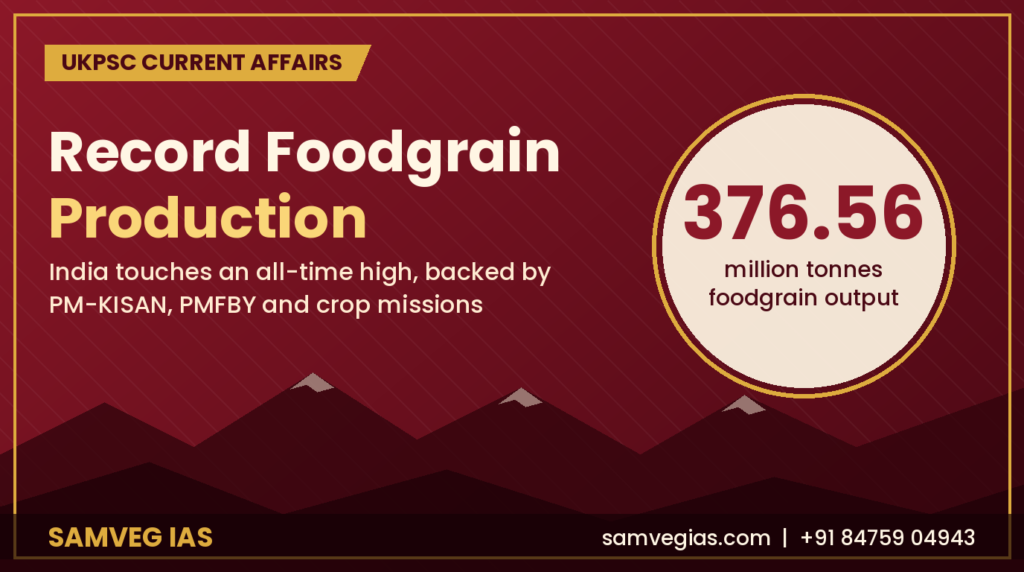
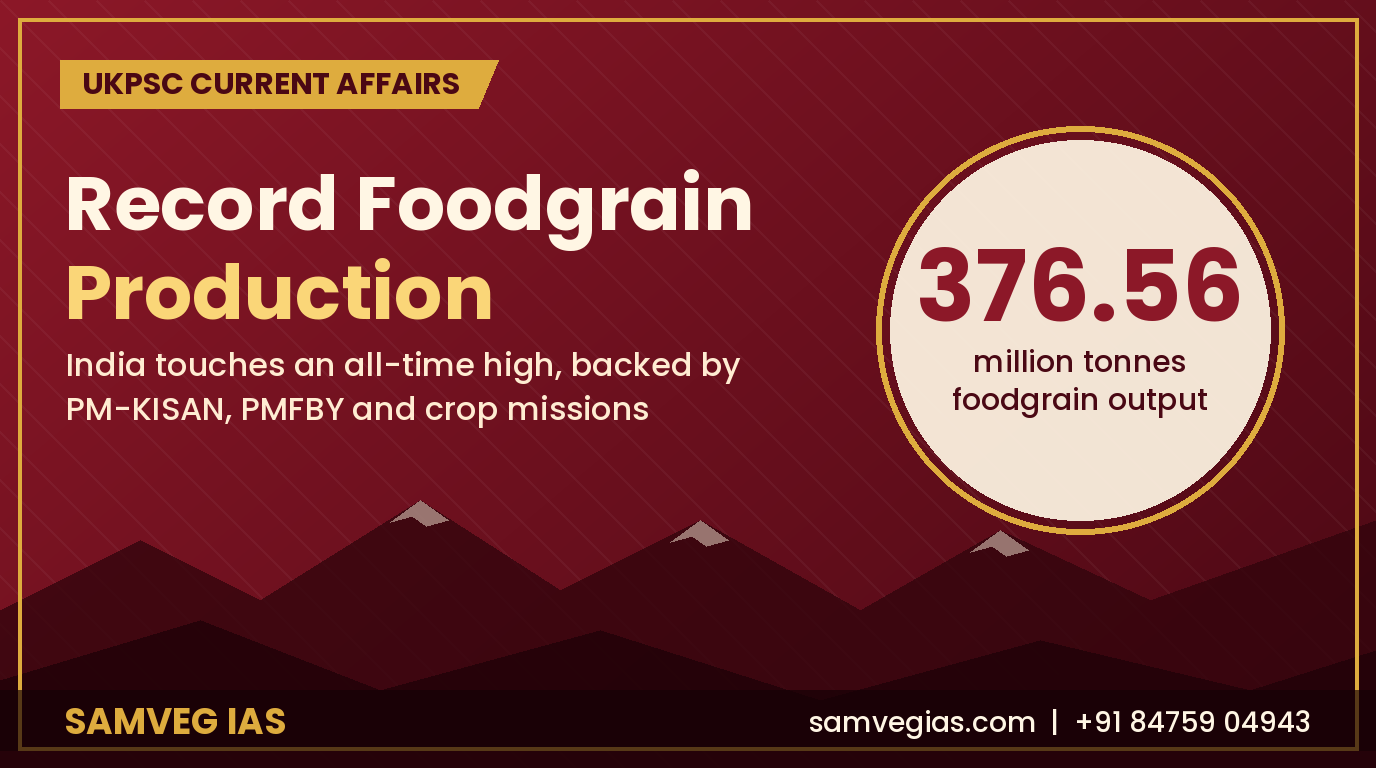
India has achieved a record foodgrain production of 376.563 million tonnes. This is the highest output in the nation’s history. Moreover, paddy, wheat, maize, pulses and oilseeds have all registered remarkable growth. However, this story goes beyond bigger harvests. In fact, it reflects a stronger and more diverse rural economy.
Beyond Record Foodgrain Production: Income and Security
Alongside higher output, the government has focused on farmers’ risk protection and income security. For instance, PM-KISAN (Pradhan Mantri Kisan Samman Nidhi) has transferred more than Rs 4.27 lakh crore directly to farmers’ bank accounts. This money has reached farmers through 22 instalments. As a result, over nine crore farmer families receive regular annual income support.
At the same time, the Pradhan Mantri Fasal Bima Yojana (PMFBY) acts as a strong insurance shield. It protects crores of farmer applicants against crop losses from natural disasters and other adverse conditions.
Record Foodgrain Production and a Diversified Rural Economy
Meanwhile, investments in irrigation, rural roads, warehouses and cold chains have strengthened agriculture. Together, they support all three critical pillars: production, storage and market access.
Today, agriculture reaches far beyond the boundaries of the farm. Dairy, fisheries, poultry, horticulture and beekeeping now add to farm incomes. Similarly, food processing, rural industries, solar energy and services create new livelihoods. Consequently, this transformation generates jobs, raises rural incomes and builds resilience in farming communities.
Ultimately, the government’s vision goes beyond supporting farm activity. It aims to build an ecosystem where agriculture drives economic growth, entrepreneurship and rural development.
Pulses, Oilseeds and Cotton Missions: Self-Reliance and Price Security
For a long time, pulses, edible oils and cotton remained below their full potential. India depended on imports for pulses and edible oils. Meanwhile, cotton farmers often faced volatile global markets. Therefore, the government gave these sectors special priority. It also launched separate missions to address their challenges comprehensively.
National Pulses Mission
The National Pulses Mission works across the entire value chain, from seeds to markets. Its goal is to raise both the area and productivity of tur, urad, masoor, gram and other pulses. For this purpose, it promotes high-yield varieties and cluster-based farming. In addition, it supports processing units, a stronger MSP (minimum support price) framework and government procurement. It also backs storage facilities and export support.
The objective is clear. India should become fully self-reliant in pulses and cut its import bill. Equally, farmers should earn sustainable incomes from these high-value crops.
Oilseeds Mission
Similarly, the Oilseeds Mission focuses on mustard, soybean, sunflower, sesame and palm oil. However, it is more than a production programme. Instead, it forms part of a national strategy for self-reliance in edible oils. Thus, it strengthens the country’s oil security and gives farmers better prices. The mission uses scientific methods, modern practices and better market linkages to lift productivity.
Cotton Mission
Likewise, the Cotton Mission promotes high-yield and pest-resistant cotton varieties. It also supports advanced farming systems, integrated pest management and crop diversification. Furthermore, it links farmers with the textile value chain and improves quality. Cotton is a major cash crop for millions of Indian farmers. Hence, the mission aims for higher output, stable incomes and globally competitive quality.
Overall, these missions seek to reduce import dependence. At the same time, they strengthen farmers’ incomes and India’s agricultural economy.
Why Record Foodgrain Production Matters for UKPSC and UPSC
Notably, record foodgrain production links to food security, farm incomes and self-reliance. Therefore, aspirants should remember the key figures, schemes and mission goals. For a state-level view, read our note on Uttarakhand wheat procurement 2026-27. You can also follow official updates from the Department of Agriculture and Farmers Welfare.
Preparing for the UKPSC Upper PCS 2026 prelims? Join our UKPSC 2026 Prelims Test Series for regular practice.