
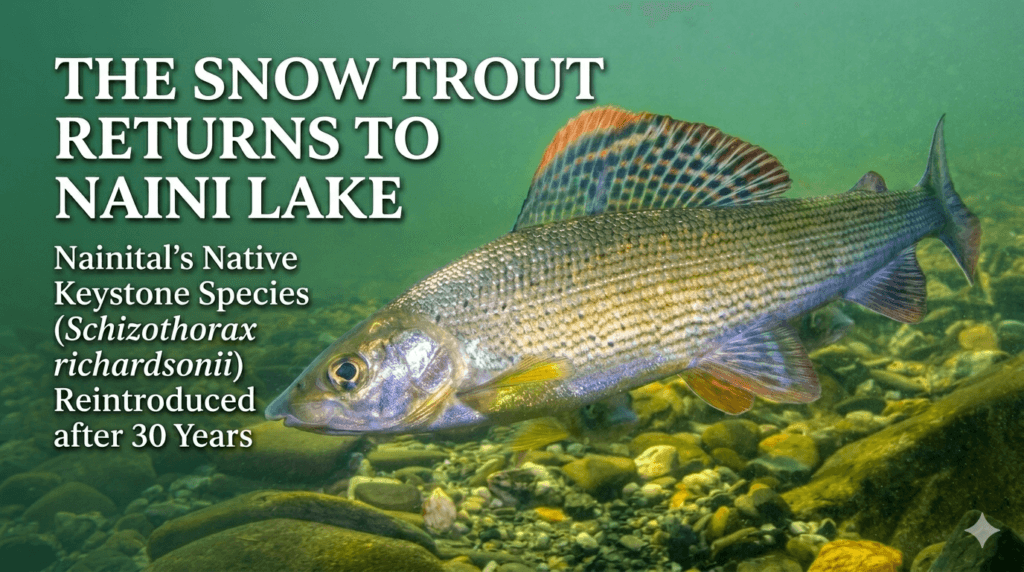
Reintroduction of Himalayan Snow Trout to Naini Lake, Nainital: A Milestone for Uttarakhand’s Aquatic Conservation
In April 2026, scientists from the Department of Zoology at the DSB Campus of Kumaun University, Nainital, successfully reintroduced the Himalayan Snow Trout (locally called Asela) into Naini Lake, Nainital after an absence of nearly three decades.
This landmark conservation initiative marks a major ecological breakthrough. It provides clear evidence that restoration and water quality improvement efforts at Naini Lake over the last two decades are yielding positive results.
About the Himalayan Snow Trout
- Scientific Name: Schizothorax richardsonii
- Local Name: Asela or “Himalaya ki Macchli”
- Geographical Range: It is a primitive cold-water fish species native to high-altitude Himalayan rivers and lakes. Its native range encompasses Jammu & Kashmir, Himachal Pradesh, Uttarakhand, and North-East India It co-evolved with the formation of the Himalayas.
- Ecological Status
- IUCN Red List Status: Vulnerable (due to habitat fragmentation, damming, climate change, and overexploitation).
- Ecological Indicator: It acts as a keystone species and an environmental health indicator for Himalayan aquatic systems due to its high sensitivity to pollution and low dissolved oxygen levels.
Why Did the Species Vanish from Naini Lake?
Up until the 1990s, Snow Trout was a dominant native species in the Kumaon lakes (Naini, Bhimtal, Sattal). However, it completely disappeared from Naini Lake due to several anthropogenic and environmental factors:
- Severe Eutrophication: High influx of sewage, urban runoff, and tourism-related waste led to excessive nutrient loading, causing dense algal blooms.
- Depletion of Dissolved Oxygen: The decomposition of algal blooms caused oxygen levels in the mid-to-lower layers of the 28-meter-deep lake to plummet to near-zero levels.
- Invasive Species Competition: The introduction of exotic, aggressive fish species (like the Brown Trout and Common Carp) outcompeted the sensitive native Snow Trout for food and sub-optimal habitat spaces.
The Scientific Breakthrough: Lab to Lake Reintroduction
The revival project was executed under the leadership of Prof. Harish Chandra Singh Bisht at Kumaun University.
- Aquaculture Technologies: Scientists successfully bred and raised around 300 Snow Trout fingerlings in lab settings. The project utilized advanced Biofloc Technology Centre and Recirculating Aquaculture Systems (RAS) to achieve this. Biofloc technology uses beneficial microbial clusters to maintain water quality and recycle waste into protein-rich fish food.
- Controlled Adaptation: Scientists released the fingerlings into specialized protective cages submerged in the lake. They strategically placed these cages near the lake’s bottom aeration zones. This ensures the young fish can safely acclimatize to the natural lake environment without immediate threat from predators.
Ecological and Environmental Significance
The reintroduction of Asela is expected to significantly accelerate the self-purification and ecological stabilization of Naini Lake:
- Natural Biological Control: Snow Trout feed directly on algae, moss, and detritus. Their presence will naturally restrict excessive algal blooms and bio-fouling, thereby maintaining pristine water clarity.
- Restoration of Food Chain: Reintroducing native keystone species corrects the ecological imbalance created by invasive fish species over the last 30 years.
- Proof of Concept: The survival of these sensitive fish confirms that artificial aeration grids (installed at the lakebed) and desilting drives have successfully minimized toxic chemical loads like nitrates and phosphates.
Key Prelims-Oriented Facts about Naini Lake
- Origin & Geography: It is a natural freshwater lake of tectonic origin. It is shaped like a crescent or kidney, situated in the heart of Nainital.
- Scriptural Mention: In the Skanda Purana, Naini Lake is referred to as Tri-Rishi-Sarovar (associated with Sages Atri, Pulastya, and Pulaha).
- Primary Feeder: Balia Nala is the primary natural feeder stream of Naini Lake.
- Unique Feature: The bridge at the southern end (Tallital) houses the world’s only post office located on a lake bridge.
Relevance for UPSC & UKPSC Examinations
This topic “Reintroduction of Himalayan Snow Trout to Nainital” sits at the crucial intersection of Environment, Ecology, and Regional Geography. It is highly relevant for both Civil Services aspirants and state service candidates.
Syllabus Mapping
- UPSC Prelims: General issues on Environmental Ecology, Bio-diversity, and Climate Change.
- UPSC Mains (GS Paper III): Conservation, Environmental Pollution & Degradation, Environmental Impact Assessment.
- UKPSC Prelims: Geography of Uttarakhand, Natural Resources, and Environmental issues of the state.
- UKPSC Mains (GS Paper VI / State-Specific Paper): Geography, Ecology, and Environmental challenges of Uttarakhand; Conservation initiatives by state universities.
Sample Questions for Practice
1. Preliminary Examination (Objective Type)
Q1. Consider the following statements regarding the Himalayan Snow Trout (Schizothorax richardsonii):
- It is an invasive fish species recently introduced to the Central Himalayan region to control algal blooms.
- It is classified as ‘Endangered’ under the IUCN Red List of Threatened Species.
- It serves as an excellent ecological indicator for dissolved oxygen levels in high-altitude aquatic ecosystems.
Which of the statements given above is/are correct?
- (a) 1 and 2 only
- (b) 3 only
- (c) 2 and 3 only
- (d) 1, 2, and 3
Answer: (b) 3 only
Explanation: Statement 1 is incorrect because it is a primitive, native keystone species, not invasive. Statement 2 is incorrect because its IUCN status is ‘Vulnerable’. Statement 3 is correct as it is highly sensitive to pollution and low dissolved oxygen.
Q2. With reference to the geography and culture of Uttarakhand, consider the following pairs:
| Feature / Location | Associated Fact |
| 1. Naini Lake | Mentioned as Tri-Rishi-Sarovar in Skanda Purana |
| 2. Balia Nala | Primary natural feeder stream of Naini Lake |
| 3. Tallital Bridge | Houses a unique floating post office |
Which of the pairs given above are correctly matched?
- (a) 1 and 2 only
- (b) 2 and 3 only
- (c) 1 and 3 only
- (d) 1, 2, and 3
Answer: (a) 1 and 2 only
Explanation: Pairs 1 and 2 are perfectly correct. Pair 3 is a trap—the post office is located on a lake bridge, not a floating post office (which is famously in Dal Lake, Jammu & Kashmir).
2. Mains Examination (Descriptive Type)
UPSC GS Paper III (Environment & Conservation)
Q1. “Eutrophication of high-altitude freshwater lakes in India is rapidly changing their ecological character.” In light of this statement, analyze how the loss of native keystone species aggravates aquatic degradation. Suggest eco-technological solutions to revive such ecosystems. (150 words, 10 Marks)
UKPSC Mains (State-Specific Paper)
Q2. Discuss the ecological factors that led to the disappearance of the Asela (Himalayan Snow Trout) from the Kumaon lakes in the late 20th century. Highlight how the recent collaborative initiative by Kumaun University serves as a model for aquatic conservation in Uttarakhand. (250 words, 15 Marks