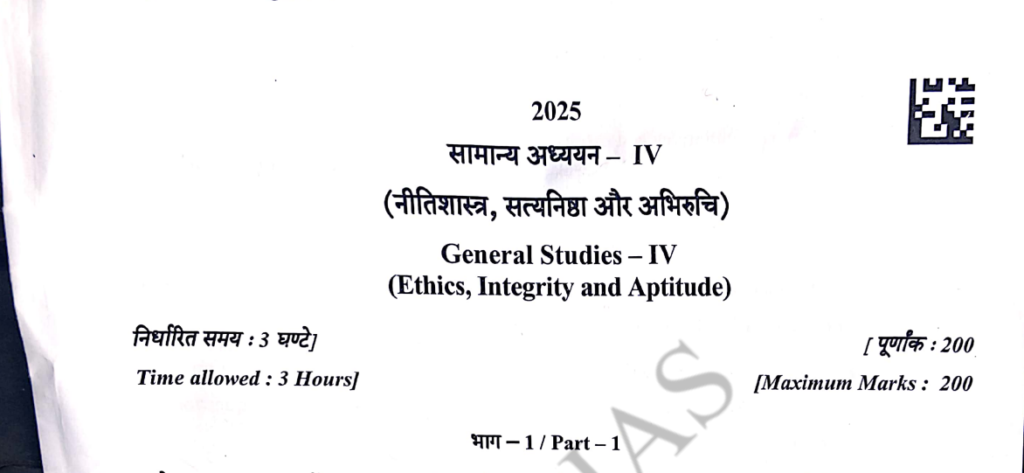
Uttarakhand: UKPSC Upper PCS Mains 2025 General Studies Paper 4, held on 29th April 2026.
UKPSC Upper PCS Mains 2025 General Studies Paper 4
Section A
Total Questions: 05 | Marks per Question: 04 | Word Limit: 50 Words
- What is the impact of degradation of moral values on the working-style of civil servants? Is it be mandatory for civil servants to follow moral values?
- In reference of emotional competencies, differentiate between Self-Awareness and Social Awareness.
- Explain the essentiality of impartiality in effective and objective administration.
- What are the key sources of international ethics?
- What are the main initiatives and mechanism have been introduced by the government to enhance the transparency in civil services working?
Section B
Total Questions: 10 | Marks per Question: 08 | Word Limit: 100 Words
- Define the role of ethics in private and public relationships.
- “‘Ekatma Manavvada’ (Integral Humanism) beholds human in his totality.” Analyse this statement.
- ‘The best way to find yourself is to dissolve oneself in the service of others.’ Review the statement.
- Do you think moral attitude is an essential attribute for good governance? If yes, then explain.
- Whether it is possible for a civil servant to be objective while discharging his administrative duties? Explain.
- According to your view point, whether Emotional Quotient (EQ) is considered more important as compared to Intelligence Quotient (IQ) for good and successful administration and governance? Comment.
- Discuss that persuasion is an important form of social influence, describing the process of persuasion, explain its importance in administration.
- How can social audit help in ensuring transparency in working of Panchayati Raj Institutions of your state? Explain with examples.
- Give your suggestions to improve the quality of services delivery in India.
- Explain the reasons for inefficient use of public funds.
Section C
Total Questions: 10 | Marks per Question: 10 | Word Limit: 150 Words (unless specified)
- ‘Socratic interests were more ethical than scientific.’ Discuss with examples.
- It is necessary for ethical governance that ‘Culture of Transparency’ should be developed instead of ‘Culture of Privacy’. Critically examine.
- Describing the aptitude, elucidate that which type of aptitudes a civil servant must possess for effective and good governance.
- “Today’s administration demands for a revolutionary change in the attitude and behaviour of public servants.” Comment.
- During the administrative works, why a civil servant should be empathetic? How a civil servant may develop empathy? Describe.
- “RTI Act-2005 plays a significant role in making good governance more practical.” Evaluate the statement with suitable examples of your state.
- Identify the pre-requisite components of probity in governance and justify why its adherence is challenging for effective administration.
- Case Study 1: A person was drowning in a river. Three persons (A, B, and C) wanted to save him for different reasons: A for a reward, B because he is a relative, and C out of duty.
- (a) Is the act of A moral or immoral? Give reasons.
- (b) Is the act of B moral or immoral? Give reasons.
- (c) Is the act of C moral or immoral? Give reasons.
- Case Study 2: As a senior administrative officer, address the decline of a once-prestigious college suffering from indifferent staff, student indiscipline, and dilapidated infrastructure.
- (a) How to improve the behaviour and work culture of teachers and staff?
- (b) How to increase the motivation of students?
- (c) How to improve college infrastructure?
- Case Study 3: A Managing Director of a pharmaceutical company faces financial irregularities and pressure to appoint “connected” individuals to the Board, threatening independence and corporate governance.
- (a) Identify the ethical dilemma.
- (b) How to uphold Corporate Governance Principles?
- (c) What are the long-term consequences?
UKPSC Upper PCS Mains 2025 All Papers:
General Hindi Paper: Uttarakhand Upper PCS Mains 2025
Essay Paper- UKPSC Upper PCS Mains 2025
General Studies Paper 1: Uttarakhand Upper PCS Mains 2025
General Studies Paper 2: Uttarakhand Upper PCS Mains 2025
General Studies Paper 3: Uttarakhand Upper PCS Mains 2025
General Studies Paper 4: Uttarakhand Upper PCS Mains 2025