
Why in the News?
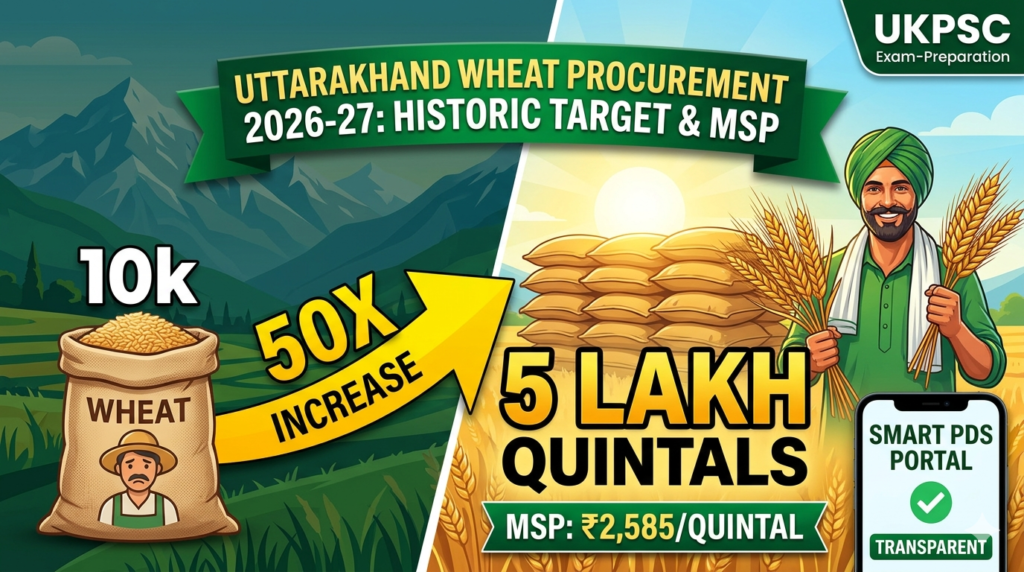
In a significant victory for the state’s agrarian economy, the Government of India has sanctioned a 50-fold increase in the wheat procurement target for Uttarakhand. The target has been revised from a mere 10,000 quintals to an historic 5 lakh (500,000) quintals for the Rabi Marketing Season 2026-27.
Commissioner/Secretary of Food and Civil Supplies, Shri Anand Swarup, noted that this adjustment follows rigorous advocacy by the State Government to address farmer dissatisfaction and ensure the benefits of the Minimum Support Price (MSP) reach a broader base.
Key Highlights of the Procurement Season
| Feature | Details |
| Revised Target | 5 Lakh Quintals (Up from 10,000 Quintals) |
| Minimum Support Price (MSP) | ₹2,585 per quintal |
| Procurement Centres | 168 (45 in Garhwal Division, 123 in Kumaon Division) |
| Technology Integration | Smart PDS Portal for registration and payments |
| Commencement Date | April 1, 2026 |
Strategic Significance for Uttarakhand
1. Economic Empowerment and MSP Realization
The increase in the procurement ceiling ensures that more farmers can sell their produce at the official MSP of ₹2,585/quintal rather than being forced into distress sales to private traders at lower rates. This is expected to directly enhance rural income and stabilize the local agriculture market.
2. Strengthening Digital Infrastructure (Smart PDS)
The state is utilizing the Smart PDS Portal to manage the entire lifecycle of procurement:
- Transparency: Eliminates the role of middlemen (Arhatiyas).
- Direct Benefit Transfer (DBT): Ensures timely and direct payments into farmers’ bank accounts.
- Efficiency: Over 1,597 farmers have already registered, with nearly 5,852 quintals procured in the early days of the season.
3. Regional Balance
By operationalizing 168 centers across both Garhwal and Kumaon divisions, the state government is ensuring geographical accessibility. This “decentralized procurement” approach is vital for Uttarakhand’s hilly and diverse terrain, reducing transportation costs for small-scale farmers.
Prelims & Mains Perspective
For Prelims:
- MSP Determination: Remember that MSP is recommended by the Commission for Agricultural Costs and Prices (CACP) and approved by the Cabinet Committee on Economic Affairs (CCEA).
- Rabi Season: Wheat is a primary Rabi crop, typically sown in winter and harvested in spring.
- Agency: ITDA and the Food & Civil Supplies Department are the key drivers of digital procurement in Uttarakhand.
For Mains:
- Issue of Procurement Targets: Discuss how central procurement targets can sometimes overlook regional productivity, and why proactive state-central coordination (as seen in this case) is essential for cooperative federalism.
- Digital Interventions: Analyze the role of “Smart PDS” in achieving the goal of “One Nation, One Ration Card” and ensuring leak-proof food subsidy distribution.
Conclusion
The massive revision in wheat procurement targets represents a shift toward more inclusive agricultural policy in Uttarakhand. By combining political advocacy (securing higher targets) with technological transparency (Smart PDS), the state is setting a benchmark for supporting the “Viksit Bharat 2047” vision through grassroots economic strengthening.