
Shadows in the Hills: The Slow Bureaucratic Erosion of Uttarakhand Van Panchayats
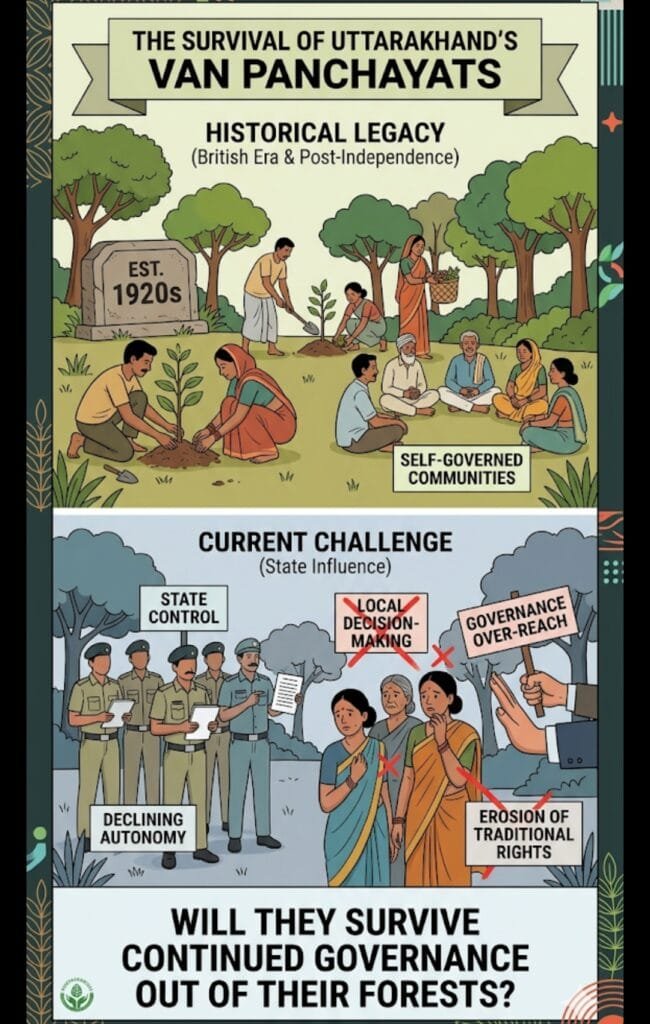
The dense oak and pine forests of the Central Himalayas have never been mere scenery; they are the lifelines of the communities that inhabit them. At the heart of this relationship lies the institution of the Van Panchayat (Forest Council)—a unique, century-old model of democratic, community-led forest management born out of radical resistance against British colonial policy. Today, however, these historic institutions face an existential crisis. This threat does not stem from environmental degradation alone, but from a steady stream of top-down state governance that risks systematically decoupling local communities from their own ancestral lands.
1. The Legacy of the Commons: A Century of Autonomy
To understand the current crisis, one must look back to the early 20th century. When the British colonial administration attempted to reserve and restrict community access to Kumaon’s forests, the hill communities responded with fierce, widespread protests. This popular resistance forced the colonial government to establish the Forest Grievance Committee for Kumaon (1921), culminating in the formal notification of the Van Panchayat Rules of 1931.
For nearly a century, these democratically elected village bodies have exercised legal rights to manage, protect, and equitably distribute produce from community forests. Today, over 11,217 Van Panchayats oversee more than 4,526 square kilometers of forest land in Uttarakhand, supporting over a million rural families. Economists and ecologists globally have long cited them as a textbook validation of Nobel Laureate Elinor Ostrom’s theories on the sustainable management of common-pool resources by local users.
2. Institutional Duplicity: The Rise of Parallel Governance
The systematic erosion of this autonomy began not with a sudden ban, but through a slow process of institutional overlap. In 1997, under the influence of global conservation funding paradigms, the state introduced Joint Forest Management Committees (JFMCs). Controlled directly by the state Forest Department, JFMCs created an immediate jurisdictional conflict with the existing Van Panchayats.
By setting up a parallel, state-backed body over the same physical territories, the government diluted the authority of the democratically elected councils. Local decision-making became tangled in bureaucratic red tape, transitioning from an organic, community-driven process to one dependent on the whims of forest officials.
3. The Legislative Pivot: From Devoluting to Deregulating
Recent policy shifts have further deepened the divide between the state apparatus and forest dwellers. In 2019, draft amendments to the Indian Forest Act attempted to absorb Van Panchayats under a generic category of “village forests,” omitting the historical nomenclature altogether—a move widely seen as an attempt to consolidate discretionary powers back into the hands of bureaucrats.
The most critical setback, however, occurred in early 2024. Between 2020 and 2022, there was real optimism as the state worked alongside multi-stakeholder groups to draft a comprehensive 58-amendment blueprint known as the Panchayati Van Niyamawali, 2023. This draft promised to update archaic land records, standardize elections, and empower councils economically.
Yet, in March 2024, the state cabinet shelved this progressive draft. Instead, it unilaterally notified token amendments to just 15 rules of the older Panchayati Van Niyamawali 2005, skipping public and community consultation entirely.
4. Legal Inconsistencies and Missed Ecological Opportunities
The 2024 policy changes brought about significant structural contradictions, notably:
- Judicial Overreach: The new amendments extended the working management plan cycles of Van Panchayats from 5 to 10 years. This directly contradicts the Supreme Court’s landmark directives in the T.N. Godavarman case, which mandates strict 5-year reviews for village forests to ensure ecological accountability.
- Economic Exclusion: Crucially, the final amendments deleted proposed provisions that would have legally linked Van Panchayats to modern green economy instruments. This effectively bars village councils from independently accessing carbon markets, watershed Payment for Ecosystem Services (PES), and international biodiversity finance.
5. The Socio-Economic Cost: Amplifying “Palaayan”
The ecological and economic cost of this administrative squeeze is high. Uttarakhand’s forests account for roughly 45.5% of its geographical area, generating ecosystem services valued at an estimated ₹95,000 crore annually. Historically, the villagers themselves have been the first line of defense against devastating summer forest fires and illegal logging.
By stripping Van Panchayats of financial autonomy and removing green incentives, the state disincentivizes conservation at the grassroots level. If protecting the forest yields no financial sustainability for a village household, the incentive to stay disappears. This directly accelerates the region’s acute crisis of out-migration (Palaayan), turning vibrant mountain communities into vacant “Ghost Villages.”
Conclusion: The Path to True Forest Democracy
If Uttarakhand is to protect its fragile Himalayan ecology while sustaining its rural populations, it must reverse this top-down trend. True ecological security cannot be managed exclusively from administrative offices in Dehradun or New Delhi.
The way forward requires a return to genuine democratic decentralization, in line with the spirit of the 73rd Constitutional Amendment. The state must resurrect and notify the comprehensive, 58-amendment Panchayati Van Niyamawali 2023 blueprint. Management plans must be realigned with the Supreme Court’s five-year mandate, and administrative oversight should shift from the Revenue Department to the Panchayati Raj Department to ensure regular, transparent local elections.
Most importantly, Van Panchayats must be recognized as legal economic actors capable of trading carbon credits and receiving ecosystem service payouts. To save Uttarakhand’s forests, the state must trust the very communities that survived the British Empire to protect their own inheritance.