
Why in the News?
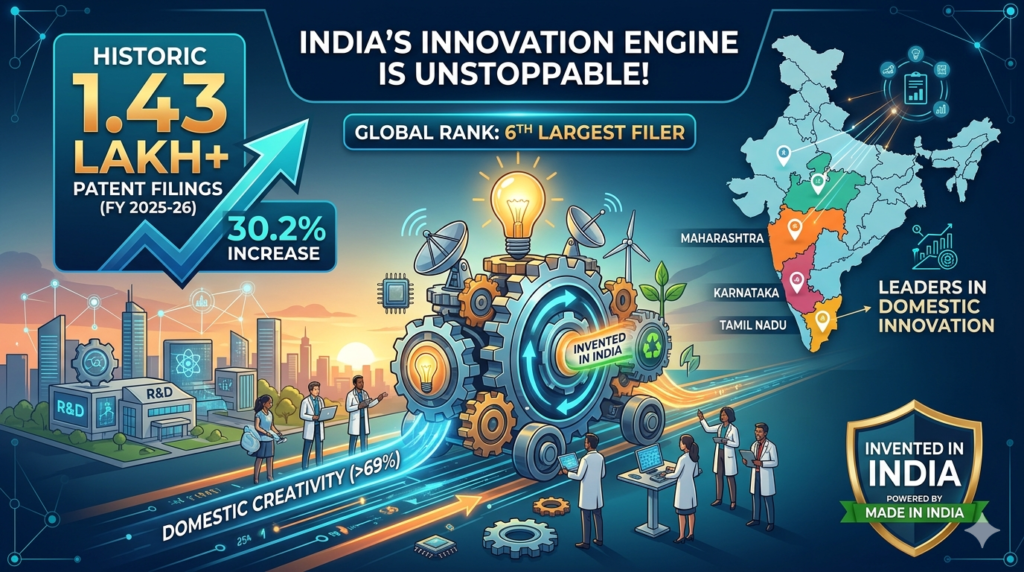
India Patent Filings 2025-26: India has achieved a historic milestone in its intellectual property (IP) journey. In FY 2025-26, patent filings in the country soared to 1.43 lakh (143,729), a massive 30.2% increase over last year. This surge signals India’s rapid transition from a service-oriented economy to a knowledge-based “Innovation Powerhouse.”
Key Highlights: The Patent Surge in Numbers
Ministry of Commerce and Industry’s latest data paints a picture of a “Confident India” leading global R&D trends:
- Domestic Dominance: For the first time, domestic applicants (Indian residents) filed over 69% of the total patents, showcasing the growing maturity of the local startup and academic ecosystem.
- Global Standing: India is now the 6th largest patent filer in the world, trailing only China, the USA, Japan, South Korea, and Germany.
- Regional Leaders: Innovation is geographically concentrated in industrial and tech-heavy states:
- Tamil Nadu: (Rank 1)
- Karnataka: (Rank 2)
- Maharashtra: (Rank 3)
- Long-term Growth: Patent filings have risen by approximately 146% over the last five years, moving from ~58,000 in FY 2021 to over 1.43 lakh today.
Factors Driving India’s Patent Boom
1. Policy Reforms & The National IPR Policy (2016)
The vision of “Creative India, Innovative India” has streamlined the IP ecosystem. Reforms include the National Intellectual Property Rights (IPR) Policy, which created a centralized framework for enforcement and awareness.
2. Institutional Support & Incentives
- Fee Exemptions: Up to 80% fee reduction for startups, MSMEs, and women entrepreneurs has lowered the barrier to entry for small-scale innovators.
- Digital Transformation: Over 95% of patent applications are now filed digitally, reducing procedural friction.
- Expedited Examination: Faster processing times have encouraged researchers to protect their inventions early.
3. Educational Initiatives
Programs like KAPILA (Kalam Program for Intellectual Property Literacy and Awareness) have successfully sensitized higher education institutions, leading to a surge in patents from universities and research labs.
Challenges and Way Forward
The Challenges:
- R&D Expenditure: Despite the surge in filings, India’s R&D spending remains at roughly 0.7% of GDP, significantly lower than global leaders like the USA (~3.5%) or China (~2.4%).
- Commercialization Gap: Only an estimated 10-15% of granted patents are successfully converted into marketable products.
- Examiner Backlog: The rapid increase in filings requires a proportional increase in qualified patent examiners to avoid a mounting backlog.
The Way Forward:
To achieve the “Viksit Bharat 2047” vision, India must focus on “Patent Quality” over quantity. Strengthening the bridge between industry and academia (the “Triple Helix Model”) will be crucial to ensure that “Invented in India” results in tangible economic wealth and global competitive advantage.
Conclusion
The record-breaking patent filings of FY 2025-26 are more than just a statistic; they represent a structural shift in India’s national mindset. By fostering a culture that protects and rewards creativity, India is ensuring that its demographic dividend translates into a sustainable, innovation-led future.