
NITI Aayog Ease of Doing R&D Report 2026: Why in the News?
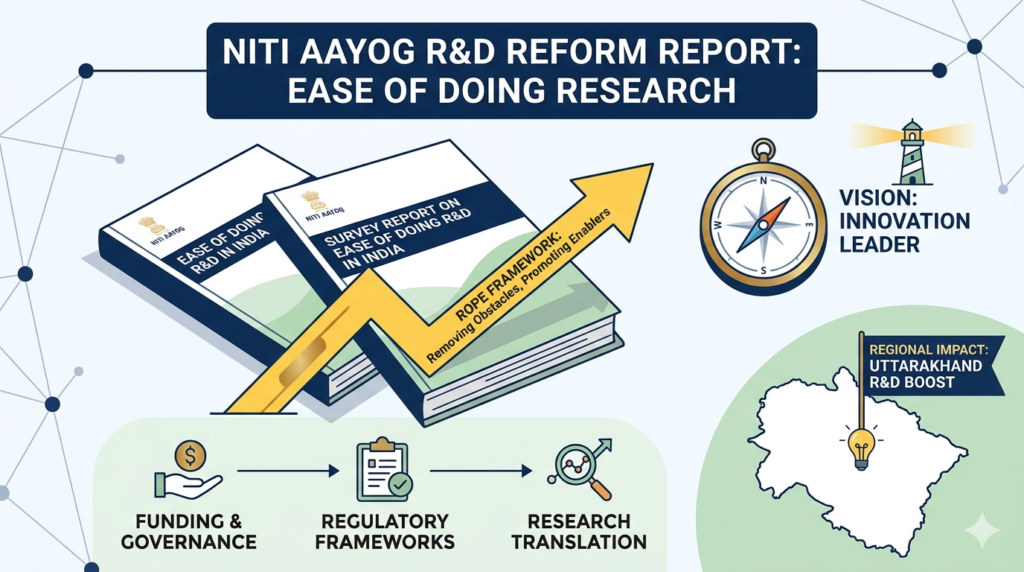
In a landmark move to bolster India’s scientific output, NITI Aayog recently released two pivotal reports: “Ease of Doing Research & Development in India” and the “Survey Report on Ease of Doing R&D in India.” The reports are the culmination of a nine-month intensive study involving 400+ institutional leaders and 850+ distinguished scientists. The goal is to transition India from a knowledge-producer to a global innovation leader by dismantling systemic bottlenecks.
Key Highlights: The ROPE Framework
The reports introduce the ROPE Framework—Removing Obstacles and Promoting Enablers—to modernize the research ecosystem.
- Dismantling Bureaucracy: Advocacy for radical reforms in procurement, exempting critical scientific equipment from rigid “L1” (Lowest Bidder) tender rules that often cause month-long delays.
- Trust-Based Governance: A shift from heavy administrative compliance to an outcome-oriented system, granting Principal Investigators (PIs) greater financial and operational autonomy.
- Lab-to-Market Translation: Focus on “Mission-mode R&D” to bridge the gap between academic research and commercial applications through Technology Transfer Offices (TTOs).
- Funding Reforms: Leveraging the Anusandhan National Research Foundation (ANRF) to democratize funding, encouraging private sector participation and CSR contributions into deep-tech startups.
Focus: Uttarakhand’s R&D Trajectory (UKPSC)
For a Himalayan state like Uttarakhand, the NITI Aayog report carries specific regional significance:
- High Potential in Higher Education: Uttarakhand boasts a Higher Education enrollment ratio of 45.7% (2021), significantly above the national average. The NITI Aayog recommendations on easing R&D can help institutions like IIT Roorkee, GBPUAT Pantnagar, and HNBGU transform from teaching hubs into research powerhouses.
- State Public Universities (SPUs): The report emphasizes seeding R&D in state universities. For Uttarakhand, this means better infrastructure and funding for regional research in Disaster Mitigation, Himalayan Ecology, and Sustainable Agriculture.
- Himalayan Innovation Hub: By adopting the “Ease of Doing R&D” protocols, Uttarakhand can position itself as a niche destination for biotechnology and environmental R&D, leveraging its unique biodiversity under a more facilitative regulatory framework.
Challenges & The Way Forward
While India has jumped to the 38th rank in the Global Innovation Index (GII) 2025, the report highlights that the Gross Expenditure on R&D (GERD) still hovers around 0.64%–0.7% of GDP.
Strategic Recommendations for Aspirants:
- Institutional Autonomy: Essential for retaining top-tier talent and reversing the “brain drain.”
- Private Sector Role: In advanced economies, the private sector contributes 70% of R&D; in India, it is less than 40%. Easing R&D regulations is the only way to invite private capital.
- Meritocracy: Moving away from seniority-based promotions to merit-based fast-track careers in scientific institutions.
Conclusion
NITI Aayog’s reports are a clarion call for “Scientific Atmanirbharta”. By shifting the focus from “process compliance” to “innovative outcomes,” India is preparing its scientific community to lead the vision of Viksit Bharat 2047.