
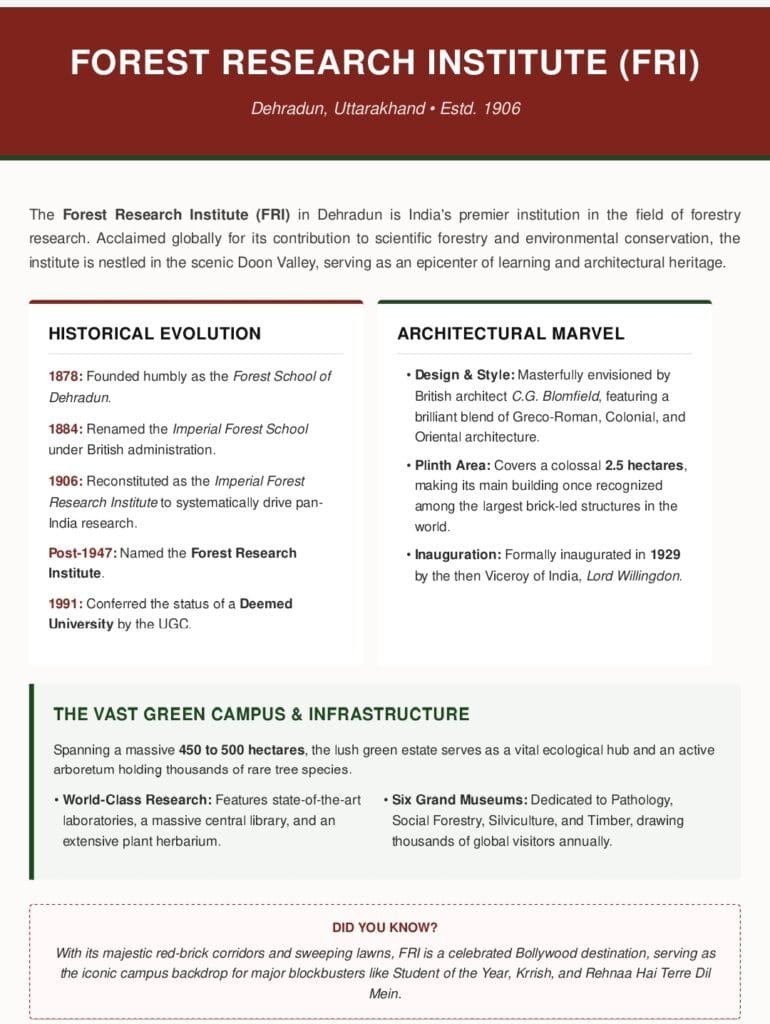
एफआरआई (FRI): विरासत, वास्तुकला और वानिकी अनुसंधान का ऐतिहासिक केंद्र
भारत के उत्तराखंड राज्य की राजधानी देहरादून में स्थित वन अनुसंधान संस्थान (Forest Research Institute – FRI) न केवल देश का सबसे प्रतिष्ठित वानिकी अनुसंधान केंद्र है, बल्कि यह अपनी भव्य वास्तुकला और समृद्ध इतिहास के लिए दुनिया भर में मशहूर है। आइए जानते हैं इस ऐतिहासिक संस्थान के सफर, इसकी अनोखी बनावट और इसके महत्व के बारे में।
1. ऐतिहासिक सफर: स्कूल से डीम्ड यूनिवर्सिटी तक
एफआरआई का इतिहास भारत में वैज्ञानिक वानिकी (Scientific Forestry) की शुरुआत से जुड़ा हुआ है। समय के साथ इसके नाम और स्वरूप में कई महत्वपूर्ण बदलाव आए:
- 1878 (फारेस्ट स्कूल ऑफ देहरादून): इसकी शुरुआत बेहद छोटे स्तर पर ‘फारेस्ट स्कूल ऑफ देहरादून’ के रूप में हुई थी।
- 1884 (इम्पीरियल फारेस्ट स्कूल): इसके बढ़ते महत्व को देखते हुए ब्रिटिश सरकार ने इसका नाम बदलकर ‘इम्पीरियल फारेस्ट स्कूल’ कर दिया।
- 1906 (इम्पीरियल फारेस्ट रिसर्च इंस्टीट्यूट): भारत में वानिकी अनुसंधान (Forestry Research) को व्यवस्थित रूप से बढ़ावा देने के लिए इसे ऑल इंडिया स्तर के संस्थान के रूप में स्थापित किया गया।
- स्वतंत्रता के बाद: देश की आजादी के बाद इसका नाम बदलकर ‘वन अनुसंधान संस्थान’ (Forest Research Institute) रखा गया।
- 1991 (डीम्ड यूनिवर्सिटी): वानिकी के क्षेत्र में इसके उत्कृष्ट योगदान और उच्च शिक्षा के स्तर को देखते हुए वर्ष 1991 में इसे ‘डीम्ड यूनिवर्सिटी’ का दर्जा दिया गया।
2. भव्य वास्तुकला: ईंटों से बनी एक ऐतिहासिक कलाकृति
एफआरआई का मुख्य भवन ब्रिटिश कालीन भव्य वास्तुकला का एक बेजोड़ और उत्कृष्ट उदाहरण है। इसकी निर्माण शैली और इतिहास से जुड़ी कुछ बेहद खास बातें इस प्रकार हैं:
- मिश्रित शैली (Architectural Blend): इस आलीशान भवन को प्रसिद्ध ब्रिटिश वास्तुकार सी.जी. ब्लामफील्ड ने डिजाइन किया था। इसकी बनावट में ग्रीको-रोमन (Greco-Roman), कालोनियल (Colonial) और ओरिएंटल (Oriental) वास्तुकला का एक खूबसूरत फ्यूजन देखने को मिलता है।
- दुनिया की सबसे बड़ी ईंट निर्मित इमारत: लंबे और राजसी स्तंभ (pillars), विशालकाय गुंबद और पूरी तरह से लाल ईंटों से बने इस मुख्य भवन का प्लिंथ एरिया (Plinth Area) लगभग 2.5 हेक्टेयर में फैला है। एक समय पर इसे दुनिया की सबसे बड़ी ईंटों से बनी इमारतों में गिना जाता था।
- उद्घाटन: इस भव्य इमारत का औपचारिक उद्घाटन वर्ष 1929 में तत्कालीन वायसराय लॉर्ड विलिंगडन द्वारा किया गया था।
3. विशाल और समृद्ध परिसर
एफआरआई का मुख्य परिसर लगभग 450 से 500 हेक्टेयर के विशाल भूभाग में फैला हुआ है। कंक्रीट के जंगलों के बीच यह परिसर देहरादून के “फेफड़ों” की तरह काम करता है।
- प्राकृतिक संपदा: यहाँ चारों तरफ फैली घनी हरियाली और दुनिया भर से लाई गई दुर्लभ वृक्षों व पौधों की प्रजातियां इस परिसर को बेहद जीवंत बनाती हैं।
- अनुसंधान के स्तंभ: संस्थान के भीतर अत्याधुनिक प्रयोगशालाएं (laboratories), एक विशाल लाइब्रेरी और एक समृद्ध हर्बेरियम (हजारों पौधों की प्रजातियों का संरक्षित संग्रह) मौजूद हैं, जो शोधकर्ताओं के लिए किसी खजाने से कम नहीं हैं।
- आकर्षण के केंद्र (संग्रहालय): यहाँ के मुख्य भवन में 6 बड़े वानिकी संग्रहालय (Museums) हैं। इनमें पैथोलॉजी, सोशल फॉरेस्ट्री, सिल्वीकल्चर, टिम्बर (लकड़ी), और नॉन-टिम्बर फारेस्ट प्रोडक्ट्स से जुड़े अनूठे मॉडल और प्रदर्शनियां रखी गई हैं, जिन्हें देखने हर साल हजारों पर्यटक आते हैं।
FRI: The Historic Hub of Forestry Research, Heritage, and Architectural Splendor
Nestled in the lush Doon Valley of Dehradun, Uttarakhand, the Forest Research Institute (FRI) is not only India’s premier institution for forestry research but also a globally renowned architectural masterpiece. Spanning across a rich historical timeline, FRI stands as a testament to scientific advancement and colonial grandeur.
1. The Historical Evolution: From a School to a Deemed University
The inception of FRI is deeply intertwined with the beginning of scientific forestry in India. Over more than a century, the institute underwent several major transformations:
- 1878 (Forest School of Dehradun): It began its journey humbly as the ‘Forest School of Dehradun’, established to train foresters.
- 1884 (Imperial Forest School): Recognizing its growing importance, the British administration took it over and renamed it the ‘Imperial Forest School’.
- 1906 (Imperial Forest Research Institute): To systematically promote forestry research across the Indian subcontinent, it was reconstituted as an all-India institute under this name.
- Post-Independence: Following India’s independence, it was renamed the ‘Forest Research Institute’.
- 1991 (Deemed University): In recognition of its outstanding contributions to higher education and research, the University Grants Commission (UGC) awarded it the status of a ‘Deemed University’ in 1991.
2. Architectural Magnificence: A Crimson Masterpiece
The main building of FRI is widely celebrated as one of the finest examples of British colonial architecture. Its design and structural scale are awe-inspiring:
- The Blend of Styles: Designed by the famous British architect C.G. Blomfield, the building features a brilliant fusion of Greco-Roman, Colonial, and Oriental architectural styles.
- A Monument of Bricks: Characterized by its endlessly long corridors, soaring pillars, and massive domes, the entire structure is built of red bricks. The main building covers a massive plinth area of about 2.5 hectares and was once counted among the largest brick-led structures in the world.
- Grand Inauguration: This architectural marvel was formally inaugurated in 1929 by the then Viceroy of India, Lord Willingdon.
3. A Vast and Rich Green Campus
Spreading over a colossal area of 450 to 500 hectares, the FRI campus acts as a vital green lung for the city of Dehradun.
- Natural Abundance: The campus is enveloped in dense greenery and serves as an arboretum, housing thousands of rare and exotic tree and plant species from across the globe.
- Pillars of Research: It features state-of-the-art laboratories, an extensive central library, and a massive herbarium (a preserved repository of plant specimens) that serves as an invaluable resource for researchers worldwide.
- The Museums: The main building houses six grand forestry-related museums covering disciplines like Pathology, Social Forestry, Silviculture, and Timber. These museums attract thousands of tourists, students, and nature enthusiasts every year.