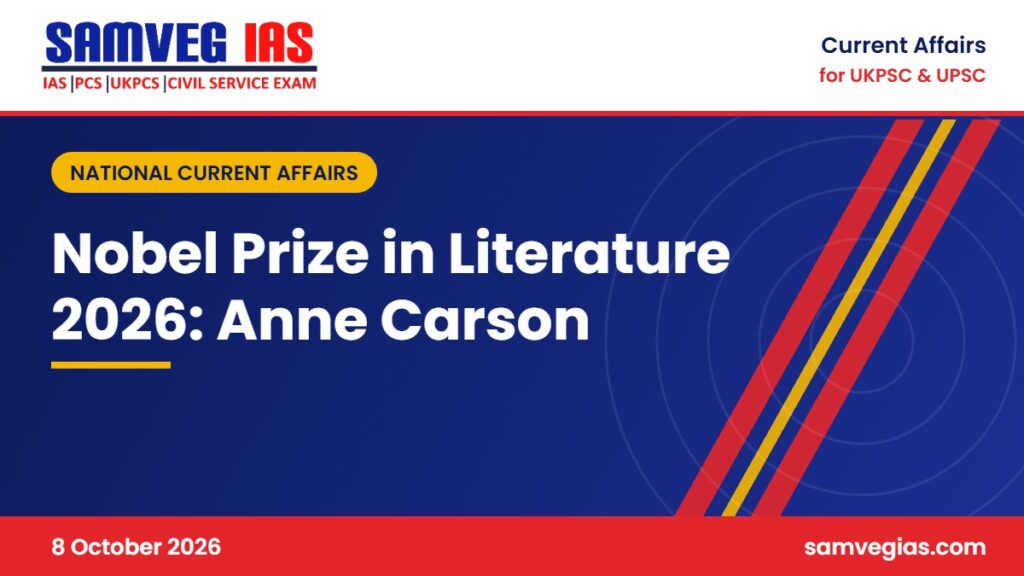
The Nobel Prize in Literature 2026 has gone to Canadian author Anne Carson. Notably, the Swedish Academy announced the prize on 8 October 2026. It honours her “bold and inventive oeuvre”. In the Academy’s words, her work is “in playful dialogue with the classical tradition”. Moreover, it “has created new forms for contemporary literature.”
Who Is Anne Carson?
Essentially, Anne Carson is a Canadian poet, essayist and translator. Born in Toronto in 1950, she grew up in Canada. Also, she is a classical scholar who has taught ancient Greek and Latin. Therefore, Greek myths and classical texts shape much of her writing.
What Makes Her Work Special
Above all, Carson’s writing breaks the usual rules of genre. For example, she mixes poetry, essay, fiction and translation in one book. Similarly, she has written a novel in verse. So, readers often find her work fresh, playful and deeply emotional.
Notable Works of Anne Carson
- Autobiography of Red (1998): Notably, a novel in verse based on a Greek myth
- Glass, Irony and God (1995): Includes the well-known “The Glass Essay”
- If Not, Winter (2002): Translations of the Greek poet Sappho
- Decreation (2005): Poetry, essays and opera
- Grief Lessons (2006): Translations of four plays by Euripides
- Nox (2010): Finally, an elegy for her brother, shaped like a folded scrapbook
About the Nobel Prize in Literature
Every year, the Swedish Academy awards the Nobel Prize in Literature. Originally, Alfred Nobel’s will of 1895 created the prize. Notably, Rabindranath Tagore became the first Indian to win it, in 1913. Meanwhile, the 2025 prize went to Hungarian writer László Krasznahorkai.
Nobel Prizes 2026 So Far
- Physiology or Medicine: Karl Deisseroth, Peter Hegemann and Georg Nagel
- Physics: Francis Halzen
- Chemistry: Henri B Kagan and Kenso Soai
- Literature: Anne Carson
Why the Nobel Prize in Literature 2026 Matters for UPSC and UKPSC
Notably, Nobel winners are a regular source of current affairs questions. So, remember the laureate, her country and one or two key works. Also, revise Tagore’s 1913 win. For official details, also visit the Nobel Prize website. Next, for a related story, read about the Nobel Prize in Chemistry 2026.
So, are you preparing for the UKPSC Upper PCS 2026 prelims? Then join our UKPSC 2026 Prelims Test Series for regular practice.