
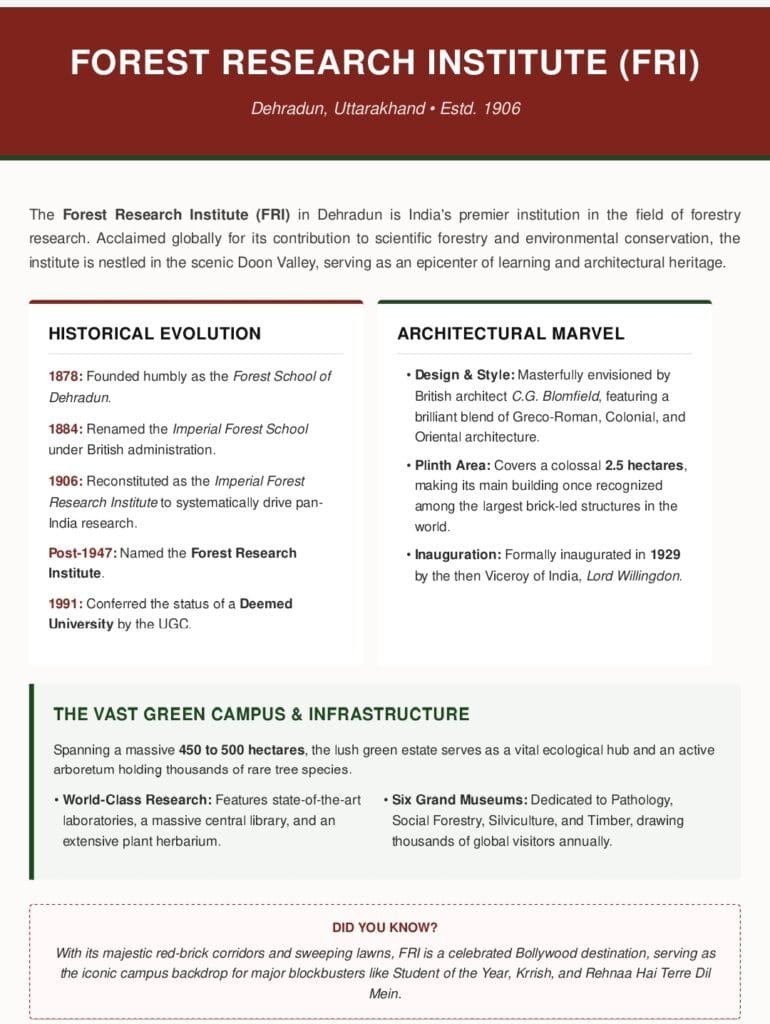
The Forest Research Institute, better known as FRI Dehradun, sits in the lush Doon Valley of Uttarakhand. Primarily, it is India’s premier institution for forestry research. Moreover, it is a world-famous architectural masterpiece. In fact, its long history reflects both scientific progress and colonial grandeur.
1. History of FRI Dehradun: From a School to a Deemed University
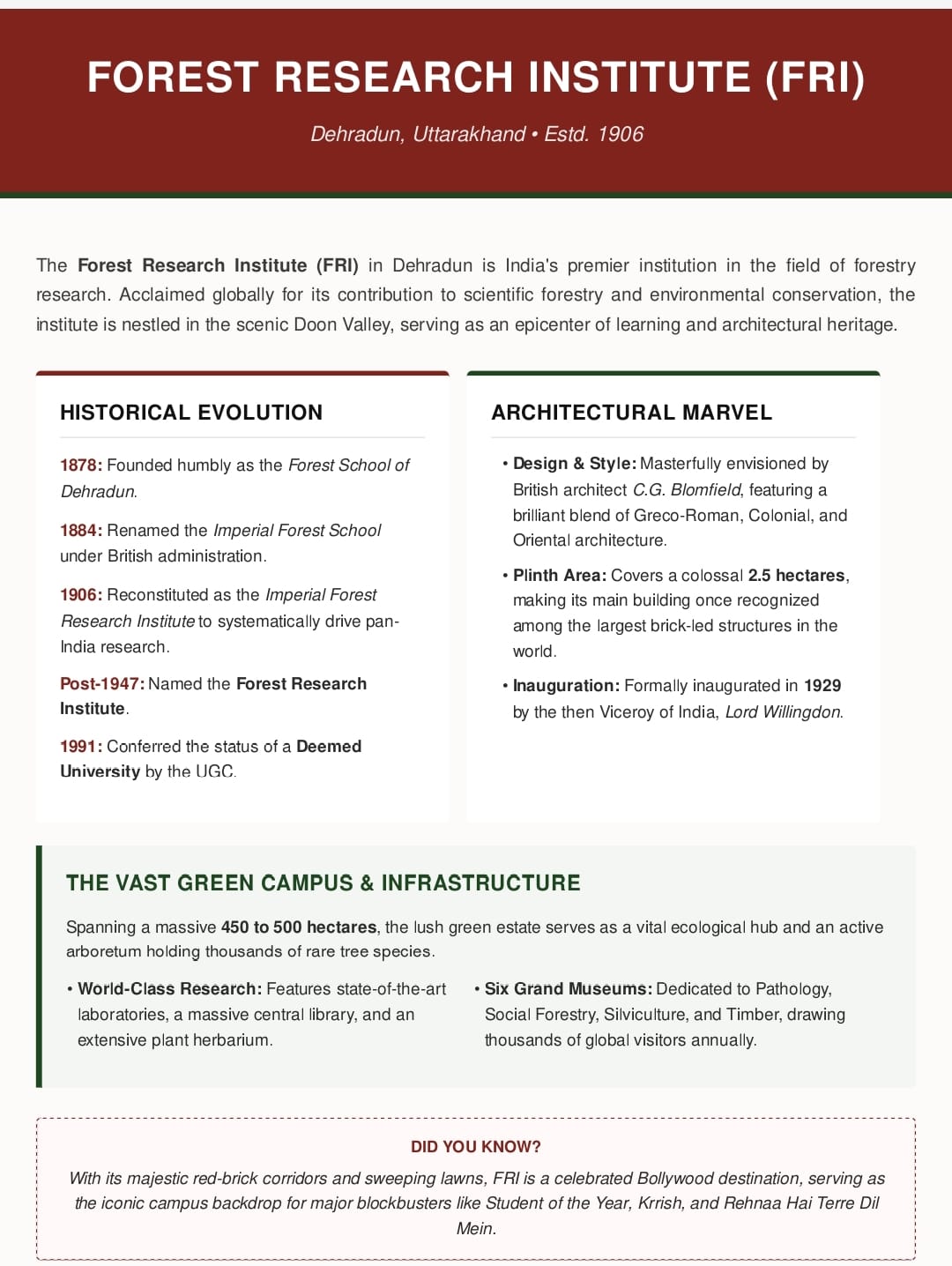
Historically, the story of FRI is closely linked to the start of scientific forestry in India. Over more than a century, the institute went through several major changes:
- 1878 (Forest School of Dehradun): First, it began humbly as the ‘Forest School of Dehradun’ to train foresters.
- 1884 (Imperial Forest School): As its importance grew, the British administration took it over. Consequently, they renamed it the ‘Imperial Forest School’.
- 1906 (Imperial Forest Research Institute): Next, it became an all-India institute to promote forestry research across the subcontinent.
- Post-Independence: After India’s independence, it took the name ‘Forest Research Institute’.
- 1991 (Deemed University): Finally, the University Grants Commission (UGC) granted it ‘Deemed University’ status in 1991. Clearly, this honoured its outstanding role in higher education and research.
2. Architecture: A Crimson Masterpiece
The main building of FRI Dehradun is one of the finest examples of British colonial architecture. Indeed, its design and scale are awe-inspiring:
- A blend of styles: The famous British architect C.G. Blomfield designed the building. Remarkably, it fuses Greco-Roman, Colonial and Oriental styles.
- A monument of bricks: Visually, long corridors, soaring pillars and massive domes define the structure. Moreover, builders used red bricks throughout. In addition, the main building covers a plinth area of about 2.5 hectares. At one time, it ranked among the largest brick structures in the world.
- Grand inauguration: Finally, the then Viceroy of India, Lord Irwin, formally inaugurated the building in 1929.
3. A Vast and Rich Green Campus
The FRI campus spreads over a huge area of 450 to 500 hectares. As a result, it acts as a vital green lung for Dehradun.
- Natural abundance: Dense greenery covers the campus. Besides, it also serves as an arboretum with rare and exotic trees and plants from across the globe.
- Pillars of research: Furthermore, modern laboratories, a large central library and a massive herbarium support researchers. Notably, the herbarium preserves thousands of plant specimens.
- The museums: The main building houses six forestry museums. Together, they cover Pathology, Social Forestry, Silviculture, Timber and Non-Timber Forest Products. Every year, thousands of tourists, students and nature lovers visit them.
Why FRI Dehradun Matters for UKPSC
Notably, questions on FRI Dehradun often appear in UKPSC and UKSSSC exams. Therefore, remember the key years: 1878, 1884, 1906, 1929 and 1991. Also, note the architect and the building’s styles. For official information, visit the Forest Research Institute website. You may also like our note on Uttarakhand’s Van Panchayats.
Preparing for the UKPSC Upper PCS 2026 prelims? Join our UKPSC 2026 Prelims Test Series for regular practice.