
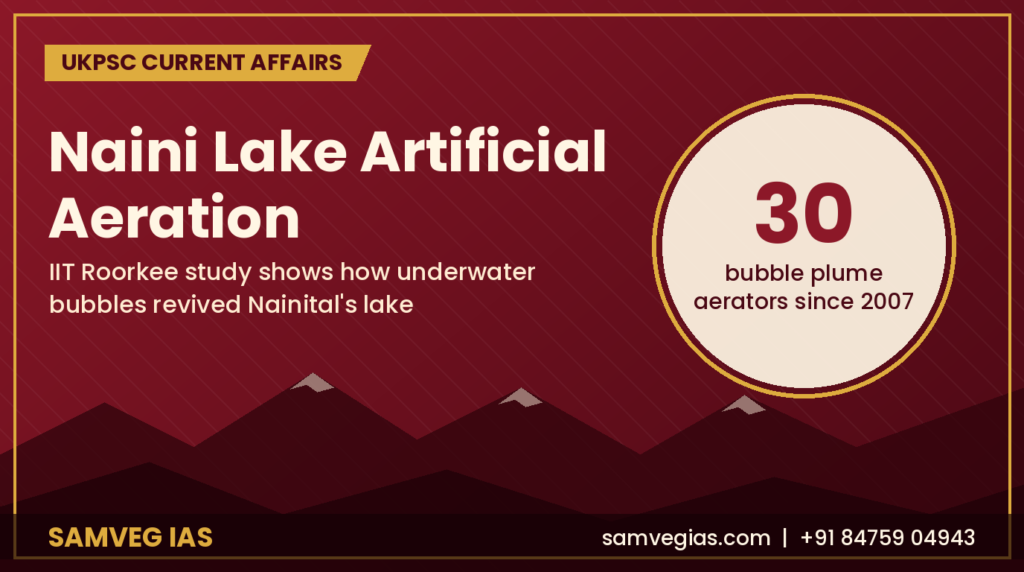
Naini Lake artificial aeration has given Nainital’s famous lake a new lease of life. For decades, this high-altitude lake in Uttarakhand faced an environmental crisis. Rapid urbanisation and nutrient-rich runoff pushed it to the brink. As a result, toxic algal blooms and massive winter fish deaths became common.
However, a long-term study by the Indian Institute of Technology (IIT) Roorkee brings good news. It shows that artificial aeration, an engineering intervention, has thrown a lifeline to the struggling ecosystem.
How Naini Lake Artificial Aeration Works
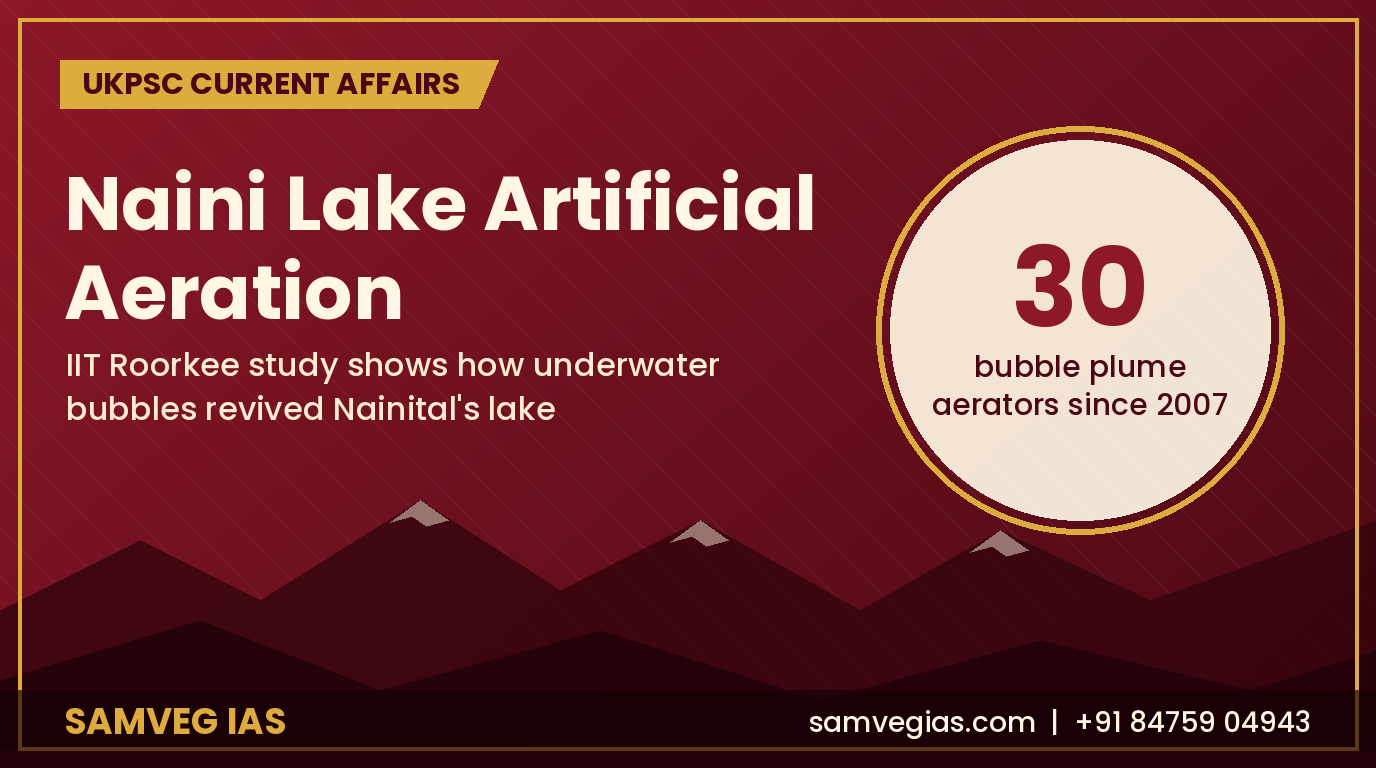
In 2007, local authorities installed 30 bubble plume aerators across the lake bed. The system continually pumps air into the water. Consequently, rising bubbles physically mix the water layers.
Key Findings of the IIT Roorkee Study
Researchers Stuti Shah, Sumit Sen and Karan Adhikari published the study in the journal Environmental Monitoring and Assessment. According to them, the intervention has improved the lake’s health in three ways.
- Breaking thermal layering: Deep lakes often suffer from thermal stratification. In this process, warm surface water traps cold, oxygen-poor water at the bottom. Before 2007, this layering lasted eight to nine months a year. Today, it lasts under four months, so the water stays well mixed.
- Balancing temperatures: Earlier, the top and bottom of the lake differed by a steep 9°C. Thanks to aeration, the gap has fallen to less than 2°C.
- Boosting oxygen levels: Circulation carries dissolved oxygen to deeper areas. Therefore, it suppresses toxic blue-green algae. It also prevents the winter fish die-offs that once plagued this tourist hotspot.
The Fight Is Not Over Yet
While the lake now breathes easier, the researchers offer a reality check. During peak summer heat, low oxygen levels still creep back near the lake bed. Hence, the study calls aeration an ongoing treatment, not a permanent cure. Its benefits depend on continuous operation and regular maintenance.
Furthermore, climate change and sewage runoff remain serious threats. So, local managers cannot afford to relax yet. For now, though, decades of data prove one point. Tackling water stagnation directly can reverse years of ecological damage. Thus, Nainital’s most prized jewel now has a fighting chance.
Why Naini Lake Artificial Aeration Matters for UKPSC
Notably, this case links lake ecology, pollution control and urban planning in hill towns. Therefore, it suits questions on Uttarakhand geography and environment. For a related story, read about the reintroduction of Himalayan snow trout to Naini Lake. You can also explore research updates from IIT Roorkee.
Preparing for the UKPSC Upper PCS 2026 prelims? Join our UKPSC 2026 Prelims Test Series for regular practice.